

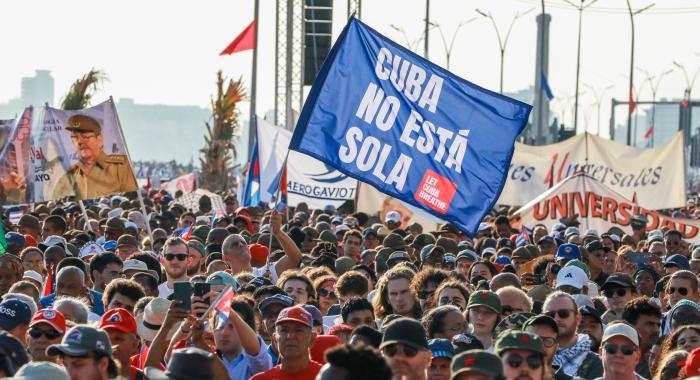
During the May Day mobilization, the hashtag #LaPatriaSeDefiende became a trending topic on social media platform X in three countries: Guatemala, Puerto Rico, and the United States. This is no small feat. In terms of communication, it demonstrates that an organized community can compete for digital space even in environments where algorithms—since they are not neutral—do not favor us.
But what exactly does it mean to be a trending topic? Simply put, it means appearing among the most mentioned topics on a platform during a given period of time. It’s not just about how many people are talking about something, but about the speed and coordination with which they do so. The algorithm—that is, the set of automatic rules that decides which content is displayed most—detects these spikes in activity and turns them into trends, amplifying their visibility.
Here a key issue arises: the algorithm doesn’t think, but it does prioritize. It does so by following criteria designed by tech companies whose interests don’t usually align with those of the public. In practice, this tends to favor content that generates a rapid reaction: controversy, confrontation, fear, or outrage. It’s no coincidence that many right-wing messages, based on hate or emotional manipulation, circulate easily. The platforms are optimized for that kind of logic.
In response to this, “breaking the algorithm” does not mean hacking systems, acting outside the law, or repeating like robots. It means understanding how information circulates on the internet and acting collectively so that alternative messages—based on truth, solidarity, and analysis—also gain visibility. It is, in essence, bringing political organization into the digital realm.
The May Day experience offers some key insights. First, coordination: many people posted on the same topic within a concentrated time frame. Second, clear identification: the use of a common hashtag (#LaPatriaSeDefiende) allows the conversation to be grouped and made recognizable to the algorithm. Third, quality: images, short videos, and clear messages are more likely to be shared organically (naturally) by other users on the network. And fourth, amplification: interacting (sharing, commenting, “liking”) with related content multiplies its reach.
Breaking the algorithm, therefore, is not an individual act but a collective one. It is not enough to be right; you have to get the message out there. In an environment where attention is limited and mediated by automated systems, visibility becomes a site of political contention.
This poses a strategic challenge for progressive forces. If the right has understood that social media is an ideological battlefield, the left cannot limit itself to engaging with it in a spontaneous or disorganized manner. It is necessary to plan and build networks capable of acting in a coordinated manner.
This implies, first and foremost, accepting that digital communication is not a complement but a central dimension of political action. It is not just about “being on social media,” but about intervening with clear objectives. It requires building a network logic that combines high-visibility nodes with a broad base of participants. It means understanding that the battle is not just for immediate attention, but for the sustained building of presence and influence over time.
Because, ultimately, the question is not just what we say, but getting people to listen to us. And in the age of algorithms, making ourselves heard is, too, a form of struggle.
Photo


