

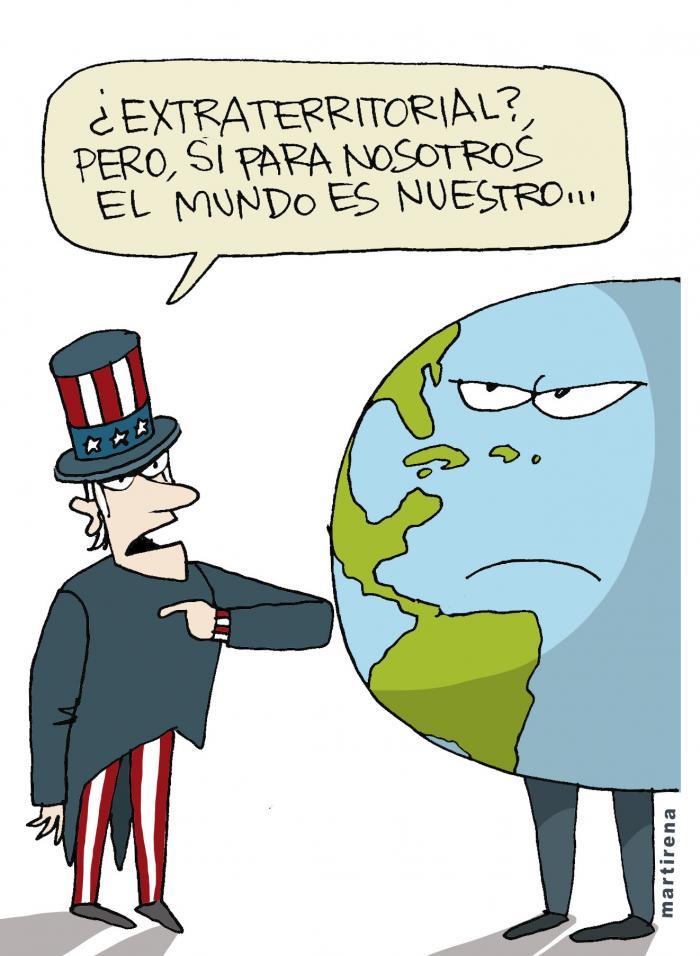
The principle of non-intervention is a fundamental norm of international law; however, in the case of Cuba, the United States has systematically violated it for more than six decades.
The UN Charter establishes, in Article 2.4, the prohibition of resorting to “the threat or use of force against the territorial integrity or political independence of any state.”
For its part, the International Court of Justice (ICJ) has defined this principle as “the right of every sovereign state to conduct its affairs without foreign interference.” Consequently, any direct or indirect coercion, whether political, economic, or military in nature, is prohibited.
The economic, commercial, and financial blockade imposed by the United States against Cuba constitutes a direct violation of this principle, as it is a unilateral coercive measure intended to subdue the will of a sovereign state.
It should be noted that the combination of regulations such as the Torricelli and Helms-Burton Acts, the continued inclusion of Cuba on the list of state sponsors of terrorism, and the 2026 measures constitute an illegal and extraterritorial framework that not only violates the sovereignty of Cuba but also that of third-party states.
The executive order of May 1st represents an unprecedented tightening of measures. Why? Not only because of the sanctions it imposes, but also because of its openly extraterritorial nature, reaching levels never before seen in U.S. legislation.
Unlike previous measures, this order establishes mandatory secondary sanctions. The key innovation is the inclusion of automatic secondary sanctions against any foreign entity—person, company, or financial organization—that operates or conducts transactions with designated Cuban entities.
In this way, anyone who fails to comply risks having their assets in the U.S. completely frozen. In other words, the order becomes an instrument of direct coercion against sovereign third-party states and threatens the global financial system.
If a foreign bank facilitates a "significant transaction" for a sanctioned entity in Cuba, it risks having its accounts on Wall Street closed or being prohibited from trading in dollars.
As if that weren't enough, the sanctions target sectors vital to the Cuban economy, such as energy, mining, and financial services, with the explicit objective of strangling the island.
The U.S. administration has attempted to justify these measures under the guise of defending human rights; however, current international law does not authorize a state to impose unilateral coercive sanctions on another based on its own assessment of the human rights situation.
Unilateral coercive measures, even when presented as humanitarian, are considered illegal without the authorization of the UN Security Council.
Fortunately, the international community is largely beginning to reject the US attempt to impose its will beyond its borders.
The European Union, Mexico, Spain, and Brazil have called for dialogue and rejected military intervention. Even German Chancellor Friedrich Merz declared that "there is no justification for U.S. intervention in Cuba."
This situation creates an environment of uncertainty that, unfortunately, discourages investment and trade with Cuba.
Sources: Prensa Latina, DW, France24, UN News, UN Charter, European Parliament: parliamentary question O-000032/2025.
Photo


