

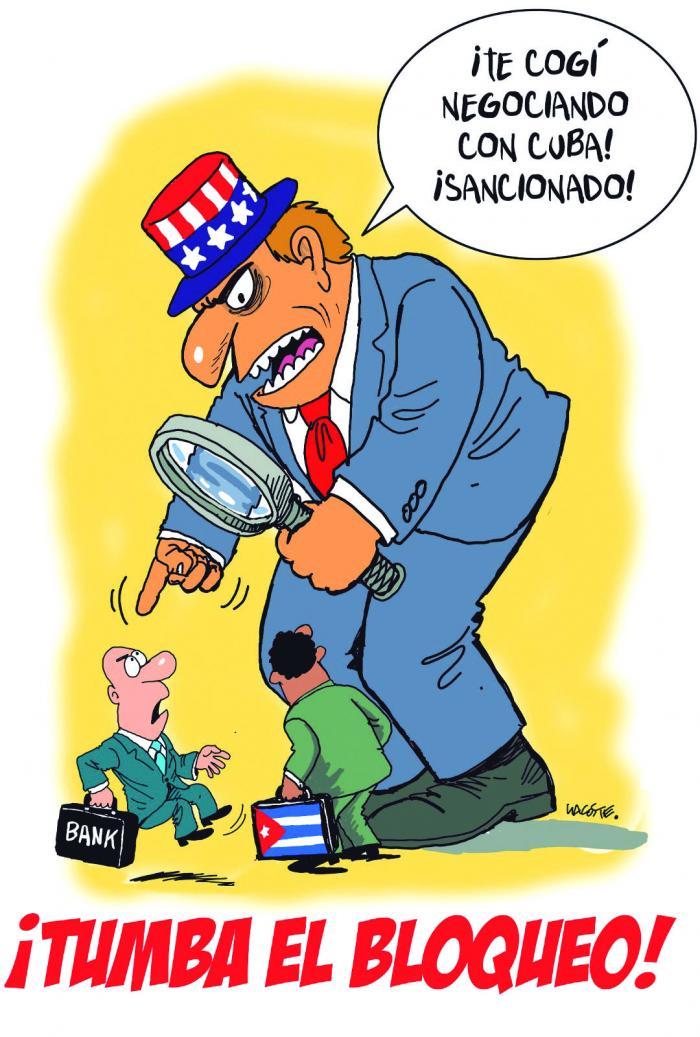
Let's imagine, just for a moment, that any nation in the world, from the most industrialized to the humblest, woke up one day unable to receive a single drop of fuel by sea. That international banks, for fear of being secondarily sanctioned, refused to process payments for crude oil. That shipping companies, insurance companies, ports in third countries—all of them—decided to succumb to the threat of having their assets frozen in the United States.
It is the hypocritical formula with which they intend to sugarcoat genocide. The siege they have designed for the island is more than a surgical or exemplary punishment; it is a template that, if applied to any country in the world, would leave it in a state of economic coma in a matter of weeks. Because what Cuba suffers today—financial strangulation, the persecution of its trading partners, and above all, the energy blockade—is not a minor evil or a collateral consequence. It is the perfect model of what a superpower can do when it decides that a country has no right to exist.
Just six days after the new Executive Order against Cuba was signed on May 1st, U.S. Secretary of State Marco Rubio announced new sanctions in the first round of an escalation that, in his own words, will extend "in the coming days and weeks." He did so, as is now customary, through a leak to the digital newspaper Axios, which acts as a privileged channel for the State Department to legitimize its attacks.
PROGRAMMED SUFFOCATION
In Cuba, this is not a hypothetical scenario. It is the daily reality since the executive order of January 2026 imposed an unprecedented oil embargo, and the current administration threatened tariffs on any country that sold or supplied fuel to the island. The result: in four months, barely one tanker has managed to dock in Cuban ports. To understand the bitter significance of that figure: the arrival of a single tanker satisfies barely 12% of the country's monthly needs.
Public transportation grinds to a halt. Trucks carrying food from the producing provinces to the rest of the island stop running. Crops are left in the fields, while urban markets are empty at dawn. Generators, which power hospitals, factories, and water treatment plants, shut down due to a lack of diesel. And the population enters a cycle of blackouts, which now exceed 20 hours a day in many areas.
Any serious economist knows this: the elasticity of energy consumption is practically zero. You can't stop using 80% of the fuel overnight without destroying the productive apparatus. That's not management; it's planned strangulation.
Stranglehold imposed by the Executive Order of January 29th, 2026, through which the president of the United States declared a national emergency and threatened to impose tariffs on any country that, directly or indirectly, sells or supplies oil to Cuba.
Its consequences are visible. All our suppliers are being intimidated and threatened; this adds to the accumulated damage of more than 65 years of blockade, with losses exceeding $2.1 trillion.
The tourism sector, the country's second-largest source of foreign exchange and employment for more than 300,000 people, is visibly affected. During the first quarter of 2026, Cuba received 48% less than in the same period of 2025.
The causes are multiple, but they all converge on the blockade. The lack of aviation fuel has led Canadian, Russian, Turkish, French, and Spanish airlines to suspend their flights to the island. This forced several tourist facilities to close temporarily, including many in the main resort area of Varadero.
SECONDARY SANCTIONS: AN AFFRONT TO THE SOVEREIGNTY OF COUNTRIES
What the new Executive Order of May 1st has introduced is an explicit and sweeping threat against any foreign entity that maintains economic ties with Cuba, regardless of whether it has any connection to the U.S. economy. The measure directly impacts the energy, mining, and financial services sectors and constitutes a flagrant violation of the sovereignty of third-party states.
These so-called secondary sanctions not only affect the Cuban economy as a whole but also act as a precision mechanism to erode the daily lives of the population. In practical terms, this means that any international bank that processes a transfer to or from Cuba can be sanctioned, blocked, or disconnected from the dollar-based financial system. And the global financial system, dominated by the U.S. dollar, acts as an enforcement mechanism that no bank wants to risk challenging.
These actions threaten to punish individuals or companies from any country that trade with the target. No connection to the U.S. is required, nor is the use of dollars, a U.S. subsidiary, or access to the U.S. financial system. Simply doing business with Cuba is sufficient. While the U.S. Secretary of State cynically claims there are no new sanctions against Cuba, reality refutes him with the stark reality of the situation.
Cuba's main export sectors are being affected at a time when other sources of foreign currency, including tourism and medical services exports, are also under severe pressure.
Washington knows this. The objective of this strategy, admitted by high-ranking U.S. officials, is to depress the standard of living of the Cuban population in order to provoke a social explosion that will induce political change in Cuba.
This is not a conspiracy theory: it is U.S. foreign policy, written in official documents and executed by executive order. But what the empire fails to understand is that the dignity of a people cannot be broken by blackouts, sanctions, or the exodus of foreign investors. Cuban resistance is deeper than any crisis, and international solidarity remains a shield that not even secondary measures can break.


