

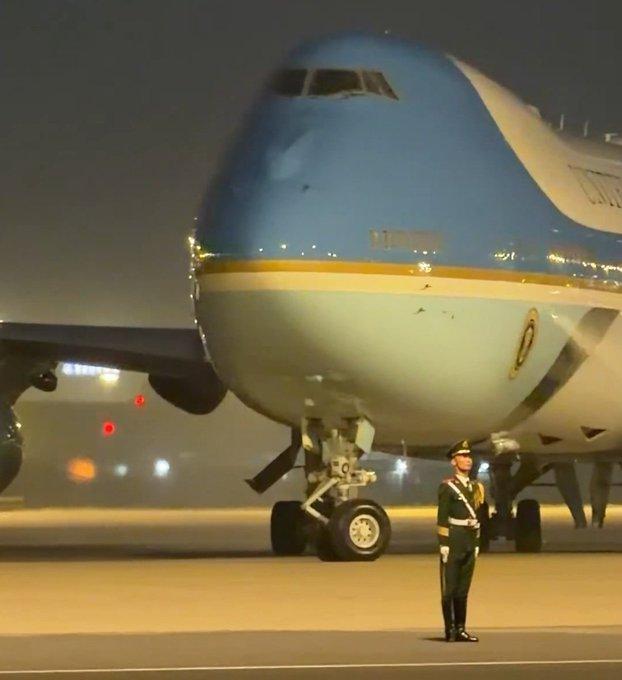
BEIJING, China—At the negotiating table—and well in advance of U.S. President Donald Trump's arrival here this Wednesday—the government of the People's Republic of China had already positioned itself on its side, outlining the cornerstones of its foreign policy: mutual respect, peaceful coexistence, and mutually beneficial economic and trade relations.
This was detailed beforehand by the Asian nation, even knowing the implications and expected results of a meeting between the leaders of these two powers, precisely when the world is shaken by conflicts and tensions fueled by the arrogant and irresponsible conduct of the White House, of which China has even been a declared target, in order to reduce its universal influence in the opposite direction: peace, international law and balanced and harmonious economic growth among countries.
The U.S. press corps has, of course, revealed other things, prioritizing everything that suits the transactional approach that administration uses to manage its foreign policy, which is more akin to the feverish and ruthless dynamics of Wall Street than to the norms of international diplomacy.
The "select" entourage accompanying the U.S. president confirms this: executives from major companies such as Apple, Cisco, Tesla, Goldman Sachs, Mastercard, Visa, BlackRock, Nvidia, and Boeing, among others.
Trump had also emphasized before his trip that his first request to Xi Jinping would be to further "open" the national economy to American corporations, in line with even more specific reports about the issues they are bringing to the Asian capital: Chinese purchases of Boeing aircraft, beef, and soybeans, as well as the creation of an investment council and a trade council to facilitate trade between the two nations.
However, the problems plaguing the planet are so grave that it seems impossible to remove them from the high-level dialogue taking place here on May 14 and 15. While the US bears the primary responsibility for the current multidimensional crisis, China has sufficient clout to intervene and exert pressure to mitigate conflicts and ease tensions.
Experts agree that, tactically, the United States enters this confrontation at a disadvantage, especially since the outcome of the war against Iran and the global implications of the closure of the Strait of Hormuz failed in their veiled objective of weakening the Chinese economy, a major recipient of Iranian oil, while the aggressor appears to be mired in a military, economic, and diplomatic quagmire from which it has been unable to extricate itself.
As a band-aid solution to its objective, the US then threatened sanctions against Chinese refineries that receive Iranian oil, which, despite threats and a military blockade, continued to flow through the Strait of Hormuz. However, the Asian giant responded in an unprecedented way, activating for the first time a mechanism that prohibits its entities from complying with sanctions: non-recognition, non-application, and non-compliance. This mechanism also allows for legal action against foreign entities in China that, due to these sanctions, refuse to do business with domestic companies and cause them harm.
It seems as if the U.S. government has too quickly forgotten its host's growing capacity to counter its overbearing excesses, as happened with the tariff whims at the beginning of Trump's term, which led China to cut off exports of eight rare earth elements and jeopardized many American companies, leaving them without immediate prospects for new suppliers.
The political stance against U.S. warmongering is another matter entirely.
China's mediation in Iran has been described as decisive in suspending an attack that was announced as incalculable and devastating, and establishing a truce that, although weak and relative, has been maintained to this day.
Regarding Cuba, and the White House's cynical and blatant threat to use even military force to overthrow the island's government, in addition to the genocidal measures that deprive it of fuel and exacerbate the suffering of its people, Beijing's pronouncement has been unequivocal:
"The intensification of the United States' unlawful and unilateral sanctions against Cuba seriously violates the Cuban people's right to subsistence and development and gravely contravenes the basic norms governing international relations. China firmly supports Cuba in safeguarding its national sovereignty and security and strongly opposes any interference in its internal affairs. We urge the United States to immediately cease the blockade and sanctions, as well as all forms of coercion and pressure against Cuba," a spokesperson for the Ministry of Foreign Affairs told the press on May 5.
More recently, on May 12, Hu Zhaoming, spokesperson for the International Department of the Central Committee of the Communist Party of China (CPC), in a message on X, accused Washington of the long-standing economic blockade against Cuba, urged the immediate lifting of all sanctions instead of intensifying them, and reiterated China's firm support for Cuba "in safeguarding its national sovereignty and security" and for its people's right "to survival and development." "The United States should do more to promote regional peace and stability," he stressed.
Is this a clear interpretation? China remains steadfast in its commitment to justice and ethics in international relations, actively advocating for peace and conflict resolution, a position diametrically opposed to the political and military violence, warmongering, piracy, and trade blackmail perpetrated by the United States.
In this context, it's impossible to imagine that these global issues will be left off the table at the talks to be held in Beijing between General Secretary of the Central Committee of the Communist Party of China, Xi Jinping, and U.S. President Donald Trump; even though there are exclusively bilateral matters to be resolved, and on which, without much fanfare, China has already drawn four red lines that cannot be crossed or questioned in the dialogue: "The Taiwan issue; democracy and human rights; the trajectory and political system; and China's right to development." A word to the wise.
However, between what is presumed and what actually comes to light, we will only know this Thursday and Friday.


