"We are brothers of the Africans, and we are prepared to fight for the Africans," Commander-in-Chief Fidel Castro Ruz once said. History has confirmed, word by word, that choice. And we are also their children, we come from them, those of the Mother Continent. No one can dispute that the children of the Island descend, as our Alejo Carpentier said, from those who arrived on something they all shared: the ship.
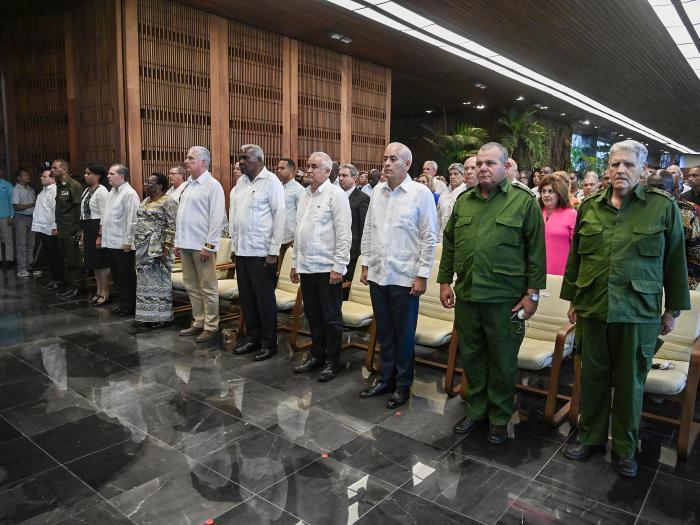
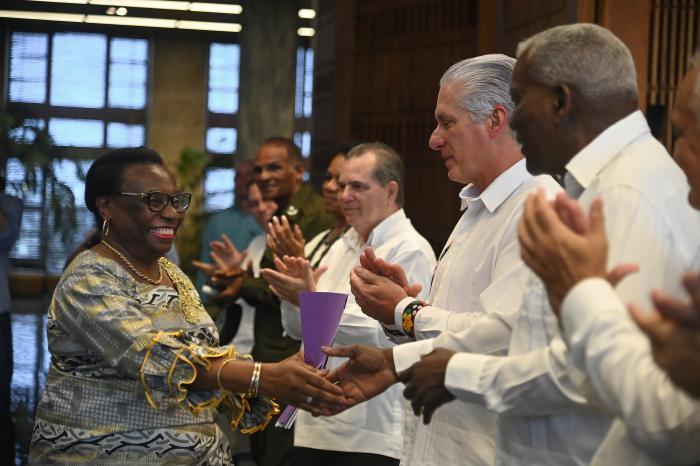
Due to its historical significance, the Central Act for Africa Day, held in the Portocarrero Hall of the Palace of the Revolution, and attended by the First Secretary of the Central Committee of the Communist Party of Cuba and President of the Republic, Miguel Díaz-Canel Bermúdez, had special meaning on Monday afternoon.
The event was also attended by Esteban Lazo Hernández, member of the Political Bureau and President of the National Assembly of People's Power and the Council of State; Inés María Chapman Waugh, Deputy Prime Minister of the Republic of Cuba; José Ramón Monteagudo Ruíz, member of the Secretariat of the Central Committee of the Communist Party and Head of its Agro-Food Department; Gerardo Peñalver Portal, Acting Minister of Foreign Affairs; as well as other leaders of the Communist Party of Cuba, the State and Government, and various agencies, institutions, and organizations in Cuba.
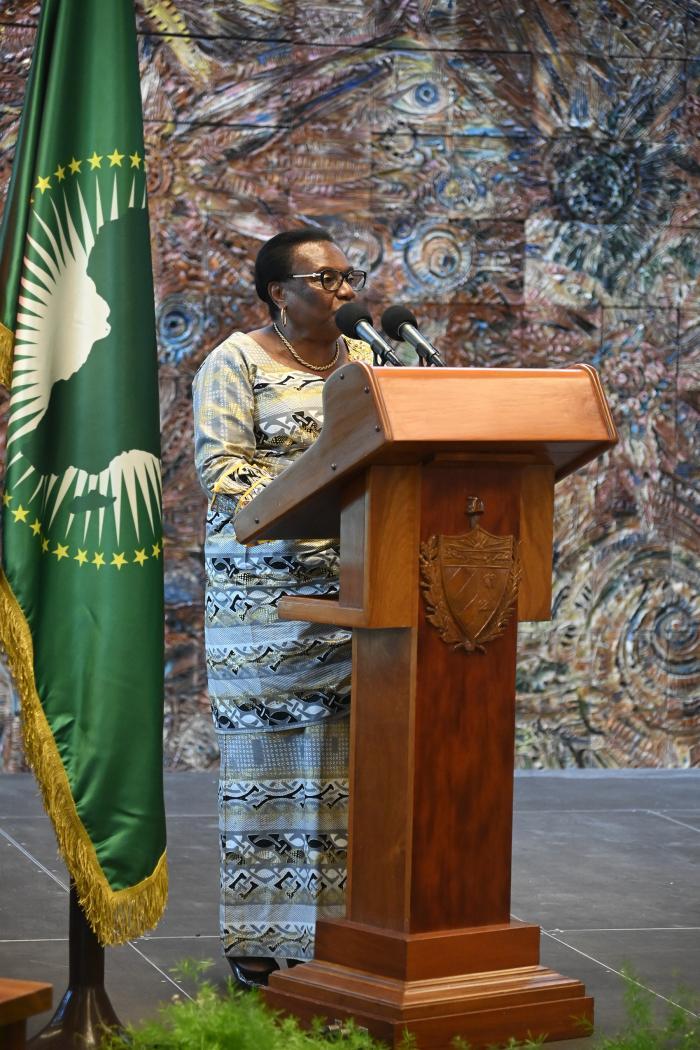
Her Excellency Professor Rosalie Kama-Niamayoua, Ambassador of the Republic of Congo and Dean of the Group of African Ambassadors, spoke at the event of sincere gratitude and feelings of friendship.
"On behalf of the entire Group of African Ambassadors, allow me to express our sincere gratitude for this show of friendship, which reflects the excellence of the historical and fraternal relations between the Republic of Cuba and the African continent," the diplomat stated on an afternoon that also included the heads of African missions and members of the African Diplomatic Corps accredited to the Island, as well as a group of Cuban internationalist combatants and civilian collaborators who fought on the Mother Continent, alongside their brothers, against colonialism, domination, racism, and Apartheid.
"As we commemorate Africa Day," the Professor said, "an immense wave of pride, solidarity, and hope sweeps across our continent and resonates among African communities around the world, especially here in Cuba." She emphasized that Africa Day is not just a historical celebration, but a living expression of the resilience, cultural diversity, youth, and immense potential of a continent with over 1.4 billion inhabitants.
Each year, the African Union proposes a theme for this May 25th Day, she explained, because this duty of remembrance is also a moment for reflection. This year, it is being commemorated under the theme: "Ensuring the sustainable availability of safe water and sanitation systems to achieve the goals of Agenda 2063." This theme reminds us, reflected the Ambassador of the Republic of Congo and Dean of the African Ambassadors Group, "that access to water and sanitation is a fundamental challenge for human development, public health, social stability, and the economic prosperity of our nations."
Later in her remarks, the professor stated that "in an international context marked by geopolitical tensions, security crises, and persistent economic and humanitarian crises, this commemoration must also be a moment of collective reflection on our interdependence and on the need to strengthen solidarity among nations." "Current crises forcefully demonstrate that multilateralism is not an option but an absolute necessity to preserve peace, promote dialogue, and address global challenges. Faced with these challenges—whether climate, health, economic, or security-related—no nation can stand alone."
Rosalie Kama-Niamayoua stated: "Africa reaffirms its commitment to an international order based on respect for international law, cooperation among states, dialogue, and the peaceful settlement of disputes." Regarding Africa and Cuba, the ambassador emphasized that the relationship between the two rests on a history of sincere solidarity, forged in the struggles for independence, sovereignty, and the dignity of their peoples. She stressed that "through the vision of Commander-in-Chief Fidel Castro Ruz, Cuba accompanied several African countries in their fight for freedom, thereby paving the way for lasting cooperation in the fields of health, science, technology, and education."
The African leader brought up a beautiful quote from Fidel Castro: The guerrilla leader had said that whoever is not capable of fighting for others will never be truly capable of fighting for themselves. This thought, she said, "powerfully summarizes the spirit of international solidarity that has always guided relations between Cuba and Africa." She shared this conviction with those present: "We reaffirm our firm and fraternal support for Cuba’s cause in the face of the economic, commercial, and financial blockade imposed and reinforced by the government of the United States of America, and we condemn the pressures and threats."
The professor affirmed that "Cuba can count on Africa," because the African Union is demanding the lifting of the blockade and the removal of Cuba from the list of countries that allegedly sponsor terrorism. "Cuba is not a threat to anyone, but rather an example of solidarity and resilience," she emphasized.
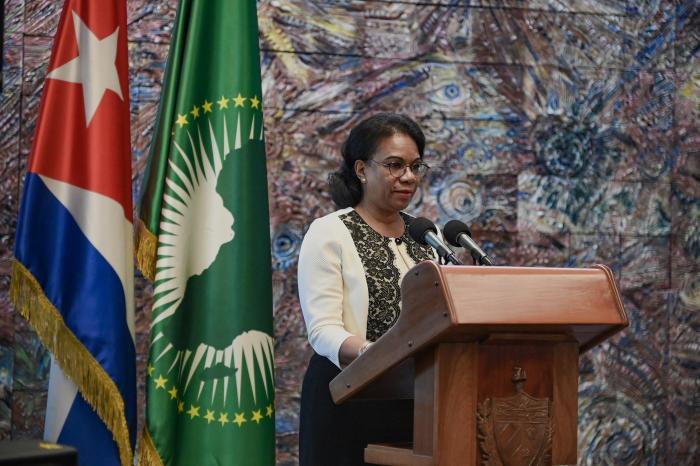
The keynote address at the main event commemorating Africa Day was delivered by Inés María Chapman Waugh, member of the Central Committee of the Communist Party and Deputy Prime Minister of the Republic of Cuba. She highlighted that this day commemorates the founding of the Organization of African Unity and is a special occasion in Cuba, an opportunity to celebrate the cultures of this sister continent, the resilience of its people, and its history of struggles for independence and against colonialism.
The Day, Inés María Chapman Waugh noted, "allows us to reaffirm Cuban-African brotherhood, our shared history, and the deep roots that unite us, as well as to pay tribute to our cooperation in the emancipatory struggles on the Mother Continent and in other noble causes."
The Deputy Prime Minister stated that, "on the Centennial of our Commander-in-Chief Fidel Castro Ruz, we remember the eternal embrace with the African people." She reflected that the traditional celebration takes place against the backdrop of growing threats of direct military aggression from the United States against Cuba; the infamous accusation against Army General Raúl Castro Ruz, leader of the Cuban Revolution; and imperialist actions to impose, by any means necessary, a change in the political, economic, and social order of the Caribbean nation.
In addition to the above, Chapman Waugh denounced the effects of a blockade that has intensified to unprecedented levels with President Trump's two latest executive orders.
With these actions, she said, "a total blockade of oil supplies has been imposed on the entire Cuban people, and secondary sanctions have been established against entities that have operated or are operating in Cuba, with the consequent strengthening of illegal measures of collective punishment against our population, and their extraterritorial reach."
"Dear sisters and brothers of the African continent," the Deputy Prime Minister added, "you are witnesses to how this fierce blockade seeks to suffocate us and cause pain and deprivation to all Cubans, particularly the most vulnerable groups in society."
"You have witnessed firsthand that children, the elderly, pregnant women, and the sick are the ones who suffer the most from the devastating impacts of the tightened blockade, such as prolonged power outages, disruptions to medical and hospital services, transportation and water supply problems, and difficulties in food production and distribution."
The Cuban leader then emphasized that, "despite the threats and the aggressive policies of the world’s greatest power against our small island, rest assured that the Cuban people will defend their sovereignty, their independence, and their self-determination, and will confront any aggression, whatever the cost."
"Our people will not be broken nor will they abandon the legacy of bravery and courage inherited from our African ancestors, who were torn from their lands, arrived in Cuba as slaves, and under the most adverse conditions managed to preserve their culture and traditions in the face of colonial impositions."
"Many of them became maroons, refusing subjugation; and they fought like lions against cruel slavery, and also for the independence of this land, which became theirs."
Cubans, she emphasized, "will never renounce the culture of resistance and the fortitude inherited from Mariana Grajales and the Maceo brothers, from Guillermón Moncada and Quintín Bandera, which will endure as an intrinsic part of our people’s identity, of which we are proud."
The leader emphasized that, "in the complex context of this celebration, we want to express our deepest gratitude to the African countries for their firm opposition to the criminal economic, commercial, and financial blockade imposed by the United States government against our people, a blockade condemned by all African nations in the United Nations General Assembly and within the African Union."
Toward the end of her remarks, Inés María Chapman Waugh asserted that, "in the current struggles, we are certain that Africa will continue to stand with us."
The celebration of Africa Day was adorned with music and dance showcasing talents from the island and the African continent. Traditional African dances, shared by students born there and currently studying at the Latin American School of Medicine (ELAM) in Cuba, reminded those present that rhythm, the yearning for freedom, and vibrant sounds were born on that continent, of which we can rightfully and passionately consider ourselves children.