

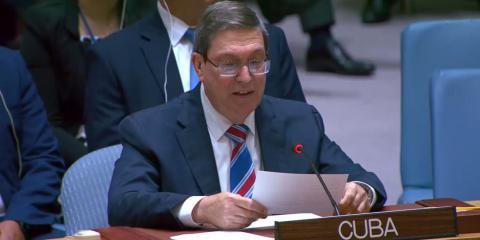
New York, May 26, 2026.— Cuba’s Minister of Foreign Affairs, Bruno Rodríguez Parrilla, spoke during the UN Security Council’s open debate on the defense of the purposes and principles of the Charter of the United Nations, where he called for strengthening multilateralism, international law, and the Organization’s central role in preserving international peace and security.
In his remarks, he acknowledged China’s leadership in convening the debate and linked the defense of the international order to the need to address conflicts and threats affecting global stability.
In his speech, the Foreign Minister denounced U.S. policy toward Cuba, which he described as a violation of international law and a threat to regional peace. Rodríguez Parrilla rejected the indictment against Army General Raúl Castro Ruz, considering it a politically motivated decision, and warned of its possible use as a pretext to justify military aggression against the island. He also noted that the energy blockade and the tightening of the embargo have serious humanitarian consequences for the Cuban population.
The head of Cuban diplomacy reiterated that Cuba does not pose a threat to the United States and reaffirmed the country’s willingness to engage in bilateral dialogue on issues of common interest, always based on respect for sovereignty and non-interference. Finally, he called on the international community, Latin America and the Caribbean, the Global South, the UN Security Council, and the UN General Assembly to act to prevent a humanitarian catastrophe or military aggression against Cuba.
Remarks by Foreign Minister Bruno Rodríguez Parrilla during the Security Council’s open debate on “Upholding the purposes and principles of the Charter of the United Nations and strengthening the UN-centered international system,” New York, May 26, 2026.
Mr. President, distinguished Permanent Representatives:
We highly value the leadership of the People’s Republic of China in the defense of international peace and security, the observance of international law; the preservation, strengthening, and appropriate reform of the United Nations, in particular the democratization, transparency, and effectiveness of the Security Council and the empowerment of the General Assembly; as well as in the construction of a multilateral international order based on sovereign equality, justice, and democracy.
Proof of this lies in the global initiatives promoted by President Xi Jinping—which we support—to address current challenges through genuine multilateral cooperation. The convening of this open debate also demonstrates this.
On September 26, 1960, at the UN General Assembly, Commander-in-Chief Fidel Castro Ruz stated: “Let the philosophy of plunder disappear, and the philosophy of war will have disappeared!” We vividly recall this in the year of his centennial.
Mr. President:
How can we speak of defending the central role of the United Nations, promoting peace and development, and safeguarding the international order based on international law and the basic norms of international relations—in order to prevent new conflicts where the strong impose themselves on the weak—without mentioning the genocide against Palestine, the imperialist aggression against the Islamic Republic of Iran, and the war in the Middle East?
The United States government, in practice, is in a position of undermining international peace and security and violating international law and international humanitarian law with regard to the Republic of Cuba.
The filing of criminal charges against the leader of the Cuban Revolution, Army General Raúl Castro Ruz, is a morally despicable act and legally arbitrary due to the abuse of the jurisdiction of U.S. courts, the manipulation of the location of the downing of the aircraft that occurred in the airspace and maritime territory of Cuba; for the terrorist and illegal missions these aircraft frequently carried out, in violation of U.S. laws, due to the impunity and complicity of U.S. authorities, and for disregarding the right of states to self-defense.
It is a politically motivated, fraudulent decision aimed at deceiving U.S. and foreign citizens, 30 years after the events took place, with the despicable intent of getting them to support a military adventure against Cuba to achieve “regime change” or “nation-building,” as they euphemistically call it now.
The oil or energy blockade that the United States imposes on Cuba is, in its effects, equivalent to a naval blockade, which is an act of war and genocide that subjects the Cuban population to conditions that threaten its integrity and existence and constitutes a cruel and indiscriminate “collective punishment” that today causes deaths, as reflected in the doubling of the infant mortality rate, from 4.0 to 9.2 per thousand live births, or the reduction in life expectancy for children with cancer from 85% to 65%.
A military attack would lead to a bloodbath. Thousands of Cubans would die defending their homeland and sacred values and causes, and young Americans would also perish, with no cause or ideal to defend, dragged into violence by an imperialist, neo-fascist policy of domination, plunder, and conquest.
I address, in particular, the citizens of the United States, especially its young people, and I appeal to your human values, your pacifist and noble sentiments, and I ask you to seek the truth and not allow yourselves to be deceived or manipulated by a corrupt, powerful, elitist clique in Miami that does not represent the American people or the Cubans residing in this country, the vast majority of whom oppose the barbarism of war and the energy blockade.
The President who would issue that order for a military attack, and the Secretaries of State and Defense who urge him to do so, would go down in history as war criminals, direct perpetrators of crimes against humanity. No justification can be offered for an act of aggression or for inhumane, coercive acts such as this, given their humanitarian impact. Let Cuba live in peace!
For more than six decades, the U.S. government has fabricated pretexts to try to justify its criminal conduct.
It has used the absurd argument of presenting the small but symbolic island as a supposed threat to the national security of the nuclear superpower—an idea that defies logic and common sense, in addition to resting on entirely false statements and insinuations.
As President Miguel Díaz-Canel has reiterated, Cuba is not and cannot be a threat. It is not an enemy of the United States nor does it wish to be one, despite significant differences with its government. Cuba has deep and fraternal ties with the American people and culture. We will continue to welcome American travelers with warmth and hospitality, even if their government restricts their freedoms; and we will welcome their businesspeople and companies with competitive projects to participate, without any discrimination, in our economic development, even if the blockade hinders it.
However, now a corrupt and immoral plutocracy brandishes the myth of our government’s incompetence and alleged corruption, and the supposed danger of a “humanitarian crisis,” as justification for foreign intervention. This is cynically stated by the very executioner who, in a cold, malicious, and deliberate manner, causes devastating effects through his actions—effects that would occur in any country in the world, regardless of its economic potential, level of development, or the nature of its political system.
Despite the lack of progress and goodwill, and the lack of seriousness and consistency on the part of the United States, we remain willing to continue talks; to address bilateral issues, without interference in our internal affairs, our political system, or our elections; and to seek forms of civilized behavior and multifaceted cooperation, particularly regarding terrorism, drug trafficking, transnational organized crime, regular and safe migration, human trafficking, mutual economic compensation, and other matters.
This is an unprecedented unilateral aggression without any justification whatsoever. Through intimidation and “secondary” sanctions applicable to third parties, the U.S. government seeks to force all States to participate, against their will, in its atrocious policies against Cuba, which will not happen.
I call on the international community to mobilize to prevent a humanitarian catastrophe that could be imposed, whether through military force or through an energy blockade and the extreme tightening of the embargo, which also kill and cause suffering.
I call on Latin America and the Caribbean to take action to preserve their status as a Zone of Peace and avoid adverse consequences that would destabilize the region.
It is time for a broad international coalition—transcending political differences, ideological approaches, and historical disputes—to put a stop to and prevent the abuses that threaten and harm national interests, peoples, and the sovereign rights of all states.
The Global South should fight for this and collectively protect itself from any reprisal, through collective voice and action and mutual cooperation. I humbly ask: the time has come for solidarity with Cuba, which has always stood by everyone, never hesitating in the face of risks—sometimes deadly—nor in the face of interests or material shortages.
I cannot help but refer to the defense of the central role of the United Nations and the promotion of peace and development, as well as the Security Council’s primary responsibility for the maintenance of international peace and security and its contribution to dialogue and the promotion of political solutions; without asking this Security Council to, realistically, at least attempt to fulfill its primary and supreme mandate regarding the military threat and the energy blockade against Cuba; nor can I refrain from encouraging the United Nations General Assembly to, in any case, resolutely exercise its broad and decisive powers, its moral, legal, and democratic authority conferred upon it by the peoples, in the situation of Cuba.
Let no one doubt that, should a moment arrive that we hope will never occur, the people of Cuba will fight to the bitter end.
Fatherland or death, we will prevail!
Thank you very much.
(Cubaminrex)


