

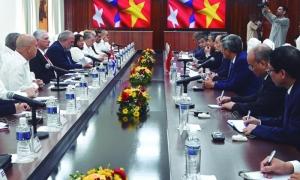
"You triumphed heroically, and Cuba also triumphed heroically and has triumphed throughout these years of infamous blockade with that same heroism," declared First Secretary and President of the Republic, Miguel Díaz-Canel Bermúdez, on Monday afternoon at the headquarters of the Central Committee of the Communist Party of Cuba, upon receiving Le Hoai Trung, member of the Political Bureau of the Communist Party of Vietnam and Minister of Foreign Affairs.
Addressing the Asian leader and the other members of the delegation on an official visit to the island, the Head of State said: "It is a great pleasure to have you and the official delegation accompanying you. This has enormous significance for us."
He also took the opportunity to extend "a fraternal greeting to Comrade To Lam, General Secretary of the Communist Party of Vietnam, who has shown understanding, sensitivity, and support for the Cuban people and our Revolution."
Díaz-Canel praised the visit as a gesture—from the leadership of the Communist Party of Vietnam, and particularly from its General Secretary—"that we greatly appreciate." He commended the fact that, after the conclusion of the 14th Congress of the Communist Party of Vietnam, "you were able to come to Cuba and explain to us the main results of that Congress."
He spoke of highly valuing this gesture because Monday's meeting makes it possible, he said, for the process of socialist construction in Vietnam to definitively become "a benchmark for all the transformations we are carrying out in our country as part of updating our socio-economic model."
This visit, the dignitary emphasized, "reaffirms the historic bonds of friendship between our Parties, our Governments, our nations, and our peoples." He stressed that such closeness is founded on the immense friendship and is sustained by the moral convergence between Ho Chi Minh—who described him as such—and Commander-in-Chief Fidel Castro Ruz.
"This presence today, which reaffirms that friendship, also has increased significance for us, because it occurs precisely at a very difficult time, when the Cuban Revolution is experiencing one of the most challenging moments in its history," the president stated, later denouncing the "multidimensional aggression" to which the island is subjected; and asserted:
"Cuba has been experiencing the effects of the longest blockade in the history of humanity, the most intense blockade, a profoundly genocidal and criminal blockade," affirmed the Cuban president at the meeting, during which the official Vietnamese delegation was also received by the President of the National Assembly of People’s Power and the Council of State, Esteban Lazo Hernández; the Prime Minister of the Republic, Manuel Marrero Cruz; the Secretary of Organization of the Central Committee of the Communist Party, Roberto Morales Ojeda; the Vice President of the Republic, Salvador Valdés Mesa; as well as by the Minister of Foreign Affairs, Bruno Rodríguez Parrilla; all members of the Political Bureau.
On a day that also included a welcome from other members of the Political Bureau, members of the Secretariat, heads of departments of the Central Committee and of the main offices of the Party's Auxiliary Structure, as well as officials from the Ministry of Foreign Affairs, President Díaz-Canel emphasized that "the country is not at a standstill," and that Monday's meeting was an opportunity to "update you on everything we are doing."
He explained the priorities that currently motivate the work in the Caribbean nation: he spoke about defense preparedness, strengthening the economy, a broad mass political movement, and communications strategy; and regarding the fifth priority, he stressed:
"It has to do with the solidarity you show us every day, which is a massive international campaign denouncing the policy of strangulation that the United States is applying against Cuba." Díaz-Canel emphasized that this is a campaign that is being carried out "by calling on the international community, on sister nations, on sister governments like yours, on communist parties and leftist parties." He made this conviction explicit:
"Today, solidarity with Cuba is a matter of strategy for the left at a global level; because what is being done against Cuba can be done to anyone."
"Anyone in the world."
The Cuban dignitary expressed his gratitude for Vietnam’s traditional and consistent stance against the economic, commercial, and financial blockade imposed by the United States against Cuba, and updated the visitor on the situation in the Caribbean nation. He also highlighted the significant contribution of Vietnamese investment projects in the Mariel Special Development Zone, which exemplify the fruitful cooperation between the two countries.
During the initial moments of the official meeting, Comrade Roberto Morales Ojeda addressed Le Hoai Trung as "dear friend," noting that he was "the special envoy of the Communist Party of Vietnam, from the General Secretary of the Communist Party of Vietnam and President of the Republic, dear Comrade To Lam, to report on the main results of the 14th Congress of the Communist Party of Vietnam."
Regarding To Lam, the Secretary of Organization of the Central Committee of the Communist Party of Cuba stated: "We always have fond memories of his visits to our country."
For his part, the member of the Political Bureau of the Communist Party of Vietnam told those present: "Today, I have the great honor of being the special envoy of Comrade General Secretary and President To Lam to participate in this meeting."
He noted that the visit comes at a historic moment, in the year commemorating the centenary of the birth of Commander-in-Chief Fidel Castro Ruz. He also referred to the brotherly people of Cuba, who are working "heroically and creatively to overcome the difficulties they are facing from abroad," under the leadership, he emphasized, of the Communist Party of Cuba, headed by Comrade and First Secretary Miguel Díaz-Canel, and also with the guidance of Comrade Raúl Castro Ruz.
Le Hoai Trung conveyed gratitude and "the fraternal greetings of our General Secretary and President To Lam to Comrade Miguel Díaz-Canel and to all the leaders of the Party and the State of Cuba." He further emphasized that officials and leaders of the Communist Party of his country are always attentive to the brotherly people of Cuba and have great interest in the situation of the Caribbean nation.
Although geographically distant, both countries share sentiments and highly value the ties forged throughout history, whose foundations rest on the friendship between Ho Chi Minh and Commander-in-Chief Fidel Castro Ruz, the friend said; and added:
"We always remember the invaluable support of the Party, the State, and the people of Cuba for the people of Vietnam." He also commented that "the Party, the State, and the people of Vietnam always value the heroism and achievements of the Party, the State, and the people of Cuba in the cause of defending sovereignty and national defense, as well as the accomplishments of the Revolution in building socialism."
The member of the Political Bureau of the Communist Party of Vietnam then stated: "We highly value and appreciate the new decisions of the Party and the State of Cuba to approve the major economic transformation policies, which were agreed upon in the Extraordinary Plenum and in the National Assembly."
The leader took a moment during his remarks to say: "We would like to express our sincere condolences for the passing of Comrade Ramiro Valdés Menéndez." And, reflecting on the value of the revolutionaries' struggle, he recounted how Vietnam rose from immense difficulties to become the society that today boasts undeniable achievements.
Prime Minister Manuel Marrero Cruz considered the information provided at the meeting by Comrade Le Hoai Trung to be particularly relevant at this time. The Political Bureau member referred to the decision, "based on the Government Program itself, to promote and accelerate a series of transformations that have been under study for a long time." It was considered, he said, "that it was the opportune moment to take this step."
"We studied Vietnam's own experience extensively," stated Marrero Cruz, who reflected that, although both nations are geographically distant, they have similar objectives. The Prime Minister of the Republic of Cuba shared an explanation of the 176 economic and social transformations and the 23 pillars that comprise the announced changes.
"We are not straying from the socialist path," affirmed the leader, who spoke about how Cuba is "seeking new formulas" to sustain the achievements of the Revolution and "strengthen our socialism."


