

Knowledge and development have never been more dangerous to humanity than they are today. It is humankind itself that, with its ingenuity and its actions, can bring about its own extinction. And we are not speaking in an alarmist way. The nuclear threats that some powers hurl at each other make it seem as if they are unaware of the shadows that still loom over Japan, when the U.S. launched—in a devastating way—the nuclear age.
While some countries have decided to disregard important treaties on the use and possession of these weapons of mass destruction, denuclearization does not appear to be among the options in the short or medium term.
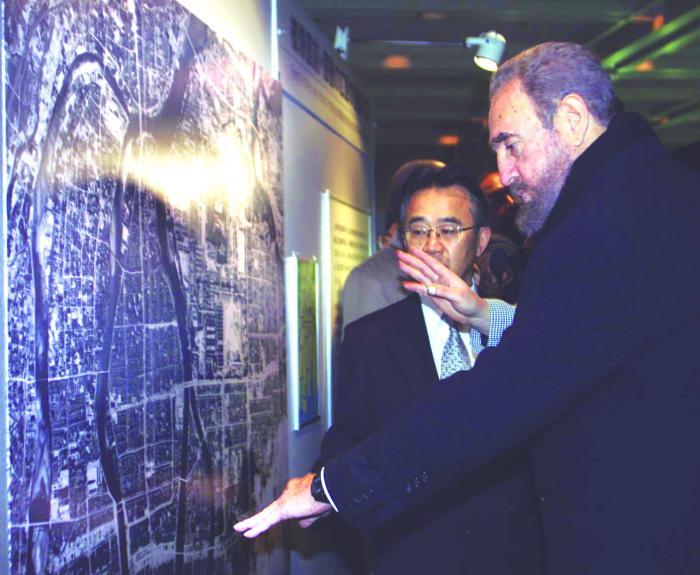
In its March 3rd, 2003 edition, this newspaper reported on Fidel Castro Ruz's visit to the city of Hiroshima, where some 140,000 people died on August 6th, 1945, after Little Boy, the atomic bomb dropped shortly after 8:00 a.m. on that city in western Japan, touched Japanese soil.
On that occasion, the Commander was able to see, in the Peace Memorial Park, built on the site of the greatest devastation caused by the atomic explosion, a black marble cenotaph, on which the names of the victims are inscribed by hand and an eternal flame burns, according to the text published by the newspaper.
"Here in Hiroshima, the world's statesmen should gather to remember what must never happen again, to together stop the hands of those who, few doubt, would again use nuclear weapons to fulfill their hegemonic designs." The Peace Memorial Park is an area over 500 meters long and about 200 meters wide. Everything there serves as a reminder of that fateful day, but especially the Memorial Museum, where, preserved in jars with chemicals, one can see the only thing that remains of many of Hiroshima's inhabitants: their "skin," as the report describes it, which also details other revealing elements of that nuclear holocaust.
"In a scale model, Hiroshima before August 6th can be seen, and also, sadly, what it became after being engulfed in flames as a consequence of the more than 6,000 degrees Celsius of heat exhaled from the epicenter of the mushroom cloud, which is said to have risen to 6,000 meters in the air."
Regarding what Fidel witnessed firsthand about one of the most sinister moments in human history, Granma detailed: "In the so-called Atomic Bomb Museum, one of the most dramatic traces of the nuclear monstrosity is preserved: the entrance steps to a bank, upon which a black shadow is the sole witness to what was once a human being, engulfed in flames and reduced to that."
He was certain, and he expressed this certainty: "Unfortunately, what happened here did not serve as a lesson to the world; on the contrary, tens of thousands of bombs of all sizes and enormous explosive power are being built. Humanity has still not demonstrated the capacity for self-preservation." Undoubtedly, a clear vision of the current context.
“May such barbarity never happen again,” he wrote in the guestbook. Ignoring this could bring us dangerously close to a new conflagration with lethal weapons, the cost of which humanity would pay en masse.
Photo


