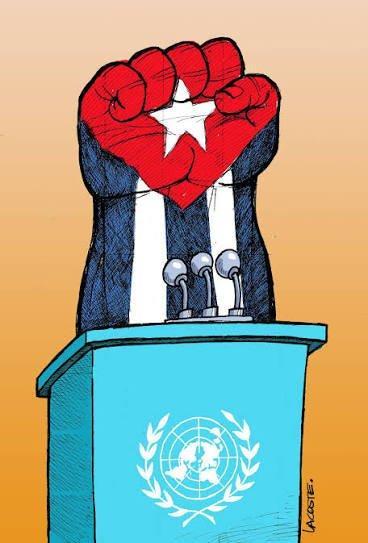
A lie repeated a thousand times does not become the truth; yet, President Trump called Cuba "an absolutely failed state" from the UN podium.
When he uttered those words, Cuban diplomats stood up and walked out of the hall. There was no need for a rebuttal; the action itself was the most eloquent response.
It was not a breach of diplomatic courtesy, but rather the basic dignity of a sovereign nation in the face of slander.
Who is truly responsible for the situation the island is facing? The answer does not lie in Havana, but in Washington; Trump himself admitted it: "I don't think more pressure can be applied, unless we go in and destroy that place."
That phrase was not a policy statement; it is a confession, acknowledging that the United States' intention is not to "help the Cuban people," but to "destroy" the Caribbean nation.
From 1962 to the present day, more than six decades of economic blockade have never once loosened the grip tightening around the Island's throat. In recent months, the current administration has tightened that grip even further.
Let us look at the 2026 economic war timeline: on January 29th, Trump signed an executive order imposing tariffs on countries that sell fuel to Cuba and declaring the island a "national security threat."
What was the result? More than 60% of the national territory plunged into darkness during peak hours, hospital medical equipment rendered inoperable, and 100,000 patients—including 12,000 children—stuck on surgical waiting lists with no scheduled dates.
Patients are dying of cancer every day, with survival rates plummeting from 85% to 65% for a reason that is painfully simple: a lack of medicines, equipment, and fuel.
On May 1st, Executive Order 14404 expanded sanctions, targeting the financial, mining, and energy sectors of the largest of the Antilles. More followed: on June 23, five entities and one individual were blacklisted; on September 2, sanctions were imposed against the International Finance Bank and an oil importing company.
Behind every list lies a minute stolen from the lives of Cubans. The numbers are cold, but the story they tell burns.
According to the report the island will present to the UN this coming October, the blockade caused losses totaling $8.083 billion between March 2025 and February 2026 alone—a 7% increase over the previous year.
The accumulated damage amounts to $178.7 billion. When adjusted for the revaluation of gold against the dollar, that figure climbs to $3.89 trillion; without the blockade, Cuba’s GDP would have grown by 10.8% in 2025. This is not an economic "failure": it is prosperity systematically strangled.
The blow to the energy sector is the most stark: a fuel deficit of 2.67 million tons, a loss of 1,400 megawatts of available capacity, and 983 fewer gigawatt-hours generated from diesel and fuel oil. Of the 15 thermoelectric units, 11 are unable to undergo their normal maintenance cycles.
That is the reality behind the "absolutely failed state" Trump referred to in his remarks: not the failure of a system, but the "success" of a superpower using every means at its disposal to prevent a small nation from functioning normally.
The president of the northern nation claims that Cuba is a "haven for hostile foreign forces threatening the United States." He asserts that there is a deeply rooted Russian and Chinese military presence on the island.
The evidence? None—not a single shred: no satellite imagery, no intelligence reports, no confirmation from UN observers. Nothing. Just the word of the executioner from the UN podium.
A word that serves to lend new legitimacy to an economic war spanning more than 60 years.
Meanwhile, what is Cuba doing? It is carrying out "profound transformations" in its economy. It is not the "failure" Trump proclaims, but rather the resilience of a system in the face of extreme pressure.
As the United States attempts to cut off every drop of oil, the island restructures its economy, boosts the private sector, and seeks new trading partners among those willing to deal on equal terms.
This is not the death throes preceding a collapse; it is the ingenuity of a small country surviving under siege.
And what of the "zero option"? Trump’s spokespeople immediately brandish it, yet they fail to mention that the alleged "official emergency statement" regarding the "zero option" never existed.
The Civil Defense General Staff denied that a document of that nature was circulating on social media: it is false; it is not a Cuban government plan; it is part of an information war—sowing panic, undermining trust, and paving the way for the "regime change" alluded to by the occupant of the Oval Office.
Trump says Cuba "will fall," but he does not say "what" falls. The Cuban system does not fall; dignity does not fall; sovereignty does not fall. The war affects ordinary families enduring blackouts of over 20 hours; what "does" fall into the mud once again is the honor of the White House—if any remains.
Cuban Foreign Minister Bruno Rodríguez once responded to Washington with a simple yet profound statement: "Cuba is not a threat. The blockade is."
That phrase is worth repeating; it is worth engraving in the conscience of every delegate at the UN. Cuba is a peaceful country; it is not the one threatening Iran with total extermination if it does not submit, nor does it threaten Venezuela, nor does it lie and boast about stealing that nation's oil—as the Yankee leader did at the UN.
The U.S. President says that "freedom will come to Cuba," but the Island is already free, having won its freedom through the sacrifice of its finest sons and daughters.
Washington may keep repeating the term "failed state," keep signing unilateral coercive measures, and keep lying from the UN podium, but a free Cuba will continue to exist.
Sources:
The New York Times, "Trump calls Cuba a failed state in UN speech," September 22, 2026.
United Nations Digital Library.
Granma, "The blockade punishes the daily lives of the people in every aspect," September 8, 2026.
Radio Havana Cuba, "Cuba denies alleged official statement regarding 'zero option'," March 13, 2026.