

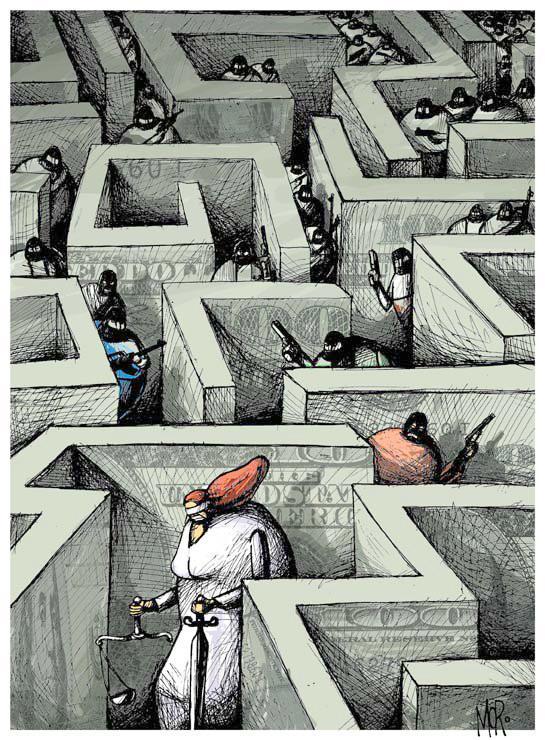
The new measures against the Cuban private sector announced by Washington on September 29th and 30th, 2026, are not merely another technical adjustment to the blockade. They represent a surgical strike against the heart of the reforms Cuba has been attempting to implement since June, when it approved 176 transformations to boost its economy for the benefit of society.
The Treasury Department’s Office of Foreign Assets Control (OFAC) revoked the authorization that—since May 2024—had allowed banks under U.S. jurisdiction to open and maintain accounts in the names of Cuban private entrepreneurs.
These accounts must be blocked immediately, and their funds reported to OFAC; account holders will require a specific license to recover their money.
"U-turn" transactions—which allowed U.S. banks to process dollar-denominated payments related to Cuba when both the origin and destination were outside the United States—were also prohibited.
"People-to-people" educational travel was eliminated, and organizing or attending professional conferences on the island was banned; additionally, indirect transactions with Cuban entities included on the State Department’s unilateral list were prohibited.
THE CONTRADICTION THAT UNDESIGNS THE MEASURE
For years, US officials maintained that the sanctions were against "the Cuban government," not against the people or the private sector.
The current administration, in February 2026, authorized the sale of oil to private Cuban companies, as part of a strategy that seemed to distinguish between the state sector and the private sector.
Now, those same authorities order the blocking of the accounts of these entrepreneurs and close their access to the international financial system.
The First Secretary of the Central Committee of the Party and President of the Republic, Miguel Díaz-Canel Bermúdez, went further: the measures "remove the masks of those who say that they are only against the Cuban Government and its companies," and added: "These actions against the Cuban private sector clearly demonstrate that their only intention is to cause maximum suffering to our people and limit the implementation of economic and social transformations."
While the member of the Political Bureau and Minister of Foreign Affairs, Bruno Rodríguez Parrilla, formulated precisely: the private sector is openly attacked, "the one that some U.S. officials say they want to help its development."
The lingering question is an uncomfortable one: if Secretary of State Marco Rubio recently stated that "Cuba has already fallen," why does he need to implement additional measures against a country that, by his own account, is already down?
Rodríguez Parrilla himself responded with irony: "Less than 24 hours ago, the Secretary of State said that 'Cuba has already fallen,' yet now it turns out he needs to implement additional measures."
THE REAL IMPACT ON ENTREPRENEURS
The Cuban private sector—MSMEs, self-employed workers, and the small businesses that have flourished in recent years—finds itself in a difficult position, lacking access to U.S. banks or to dollar transactions that pass through the U.S. financial system.
The paradox is stark: they are being punished at a time when the Cuban government itself has relaxed restrictions to allow that sector to grow.
This context exacerbates the situation; there is something deeply revealing in this sequence of events: a power that proclaims its adversary has "already fallen" has no need to strike again.
Simone Weil argued that force, when it loses all sense of limits, ends up becoming its own justification: it no longer requires reasons; it simply requires exercise.
In *Gravity and Grace* and her *Marseille Notebooks*, Weil insisted that limitless force corrupts those who wield it, because it dissolves the very concepts of necessity and justice. These measures appear to operate according to that logic.
For her part, Hannah Arendt warned that instrumental violence, when it loses its objective, becomes pure violence—destructive in and of itself.
There is no physical violence, yet there is something analogous in sanctions that seek to alter behavior—sanctions that use suffering to achieve an objective.
Literature and philosophy are useful here—not merely as decoration, but to remind us that grand concepts like power, sovereignty, dignity, and suffering take on concrete names when viewed up close. In this instance, that name belongs to a Cuban entrepreneur—part of a people being punished for desiring freedom and dignity.
With or without bank accounts, with or without dollar transactions, the private sector faces the challenge of survival. The masks are off, the promises are hollow, and there is no room for confusion (if any existed): the war is against the Cuban people.


