

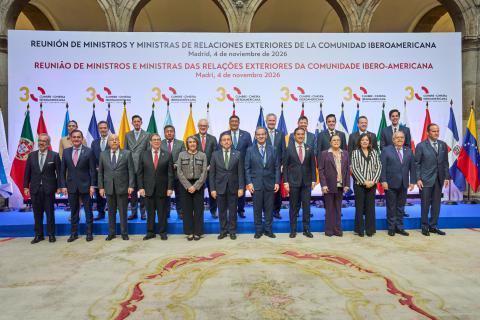
In the context of the 30th Ibero-American Summit, currently underway in Madrid, Bruno Rodríguez Parrilla—a member of the Political Bureau and Minister of Foreign Affairs—denounced on Thursday "the unprecedented tightening of the blockade, the imposition of an energy siege, and the application of secondary sanctions against individuals or entities that establish commercial relations with Cuba."
This was reported by the First Secretary of the Party’s Central Committee and President of the Republic, Miguel Díaz-Canel Bermúdez. Writing on the social media platform X, he added that the Foreign Minister reaffirmed the island's commitment "to Ibero-American cooperation, based on equality, sovereignty, and mutual respect, and aligned with the national priorities of the Ibero-American countries."
In his address, Rodríguez Parrilla emphasized "the obsessive war of economic strangulation against Cuba, which the United States has pushed to the inhumane extremes of collective punishment."
He further condemned the application of secondary sanctions against individuals or entities that engage in commercial relations with Cuba and, on behalf of the people and government of the largest of the Antilles, expressed gratitude to the Ibero-American nations that voted in favor of the resolution against the blockade.
"In the face of such arbitrariness and the abusive exercise of imperialist power, we must act in adherence to the founding principles of the Community," he asserted. Furthermore, he recalled the questions posed by the historic leader of the Cuban Revolution, Fidel Castro Ruz, at the VI Ibero-American Summit in Santiago, Chile, held three decades ago: "If we close our eyes and fail to act with the unity, clarity, and energy that this crucial moment in our history demands, what will become of our states in the 21st century? What will remain of our independence? What meaning will the goal of our struggles hold for our peoples? What real possibility will there be to achieve true democratic governance, with justice and hope for all?"
In this regard, the Foreign Minister asserted that the Ibero-American Community "still lacks answers to those questions."
He also reiterated the island’s aspiration to "achieve a future of peace and prosperity for all our peoples," as well as its "commitment to continue working during the upcoming Pro Tempore Secretariat—held by the Republic of Honduras—to strengthen Ibero-American cooperation."
Regarding the new Ibero-American Cooperation Strategy, he emphasized that it "should contribute to sustainable development and make better use of our capabilities through joint projects, the exchange of knowledge, and the pursuit of shared solutions."
Rodríguez Parrilla acknowledged the creation of the Ibero-American Alliance for Artificial Intelligence and the Ibero-American Network for Disaster Risk Reduction and Civil Protection, as well as the approval of the Ibero-American Environmental Agenda—initiatives that, he noted, will strengthen cooperation in the digital sphere, risk management, and the protection of ecological heritage in the face of the climate crisis.
At the meeting, he reaffirmed the will of the Caribbean nation to "contribute to the enrichment of the cultural and historical heritage of the Community, which reflects our common interests, from the diversity that characterizes us.
"This will only be possible if we defend, with determination, the independent action of the Ibero-American Conference, without interference, exclusions or external pressures," he pointed out.
He argued that the world today faces a "convulsive international context, marked by unilateralism, the imperialist and unviable attempt to impose peace through force, the proliferation of conflicts, violations of International Law, Human Rights and the impact of climate change."
In his words, the Chancellor conveyed heartfelt condolences for the victims of the train accident on October 28th in Toledo. Likewise, he welcomed the initiatives promoted by Spain during the last two years and the results of the numerous sectoral meetings held.
MEXICO RATIFIES POSITION
HISTORY OF SUPPORT FOR CUBA
Mexico's historic support for the Island was also heard at the meeting, where Foreign Minister Roberto Velasco, representing the president, Claudia Sheinbaum, reiterated Mexico's rejection of the blockade imposed by the United States against Cuba and stated that in terms of security its relations with all nations are governed by "cooperation without subordination" and respect for sovereignty and territorial integrity.
In the plenary session, Velasco assured that Mexico believes "in understanding between sovereign nations, in international law, in democracy, in the self-determination of peoples and in the peaceful solution of controversies." Hence, the diplomat stated, his nation maintains its "historical position" in the face of coercive economic measures against Cuba, reported the newspaper La Jornada.


