

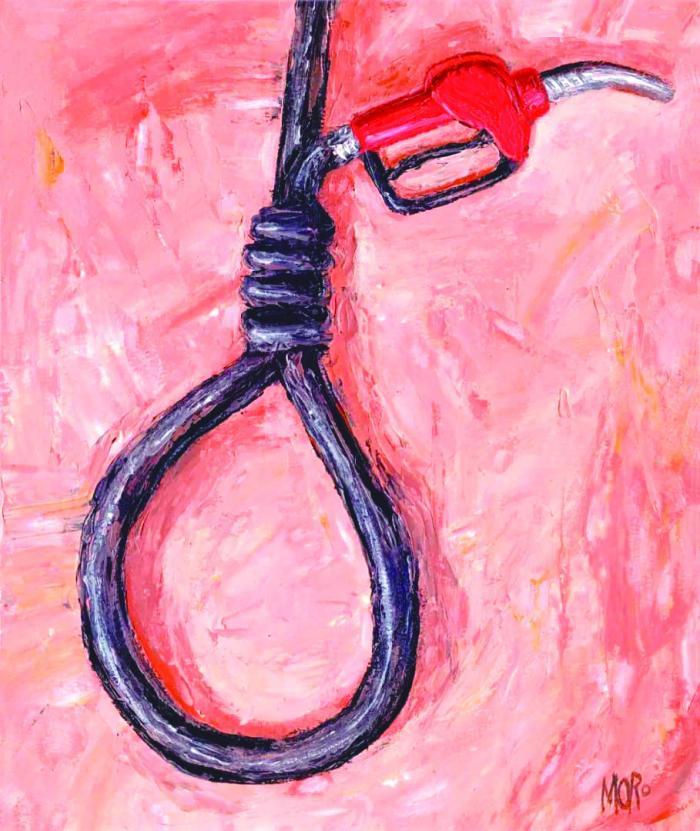
Whenever people talk or write about the blockade, the long faces and disapproving phrases of some communication and language experts appear, in addition to the current question: "is the blockade again?"
It is true that the problem with saturated terms is that they no longer describe, label, they lose the capacity for estrangement, and the reader processes them as background noise that confirms what they already believe or what they reject. That's why it's useful to look for creative terms to force you to look at the mechanism, not the label.
But hey, I don't deny that it would be useful to move the metaphor of the wall, which is the mental image of the blockade, towards closer and newer metaphors of subtraction, design and emptying.
Perhaps we should talk more about the legal architecture of this U.S. policy against Cuba, because it is not a single regulatory body, but a system of overlapping layers that has been built for decades.
Each layer provides different tools and logic, and what is new in 2026 is that the current administration has added a pillar specifically designed to project punishment, which more precisely reaches foreign entities and banks, even without connection to the U.S. financial system.
The core of this framework consists of the Cuban Assets Control Regulations (CACR)—codified in Title 31 of the Code of Federal Regulations, Part 515, and administered by the Treasury Department’s Office of Foreign Assets Control (OFAC)—which prohibit virtually all transactions by persons subject to U.S. jurisdiction that involve Cuba or Cuban nationals, unless expressly authorized.
Its ultimate legal basis is the Trading with the Enemy Act (TWEA) of 1917, which has served as the historical foundation for the embargo. Built upon this foundation was the Cuban Democracy Act of 1992 (Torricelli Act), which extended the prohibitions to subsidiaries of U.S. companies in third countries and barred vessels from third countries that had called at Cuba from entering U.S. ports.
Meanwhile, the qualitative leap in extraterritoriality was given by the Helms-Burton Act of 1996, whose most harmful piece is its Title III: it allows US citizens to sue before courts of
US to any foreign entity that "trafficks" in property expropriated after 1959.
Although its application was suspended for decades, the current tenant of the Oval Office activated it in 2019, generating dozens of lawsuits against European and Canadian investors. Title IV, in addition, allows visas to be denied to foreign executives of companies that are involved in these properties.
Now, the most relevant structural change occurs with Executive Order (EO) 14404 of the 1st. May 2026. Its importance lies in the fact that it abandons the TWEA as its main basis and is based on the International Emergency Economic Powers Act (IEEPA), the National Emergencies Act, Section 212 (f) of the Immigration and Nationality Act, and Title 3 of the U.S. Code, Section 301.
This choice is not technical. The IEEPA allows the Executive to declare a national emergency and, on that basis, block assets and authorize sanctions against non-US persons, for conduct that occurs entirely outside the US, something that the TWEA did not facilitate with the same agility.
EO 14404 creates a parallel and autonomous sanctions program to the CACR, it does not replace it, but rather adds to it as a different legal basis.
Under this new authority, the Secretary of the Treasury, in consultation with the Secretary of State, can block any foreign person operating in key sectors of the Cuban economy, energy, defense and military equipment, metals and mining, financial services and security, or any other sector that the Treasury subsequently designates.
The specific secondary sanction mechanism is activated against foreign financial institutions that carry out or facilitate "significant transactions" on behalf of or for the benefit of persons blocked under EO 14404.
Which means that a European, Asian or Latin American bank can be sanctioned not for violating a law in its own country, but for processing a payment for a Cuban entity that Washington has designated under this new regime, even if the transaction does not touch U.S. territory or institutions.
It's not a game thing. It involves the blocking of all assets and property interests that the designated person has in the US or under the control of U.S. persons.
It forces banks and companies from third countries to choose between the Cuban market and access to the US financial system, even when their operation with Cuba is perfectly legal according to their own legislation.
That is really something, as we Cubans say. OFAC has confirmed that individuals blocked under the CACR are not automatically blocked under EO 14404. A separate case-by-case determination is required, giving the administration complete discretion to gauge who it hits and when.
Meanwhile, EO 14404 is based on a previous regulation, Executive Order 14380 of January 29th, 2026, which declared a national emergency with respect to Cuba under the IEEPA and the National Emergencies Law. This declaration is the enabling legal budget for EO 14404 to operate.
Then EO 14380 established a tariff system against imports from countries that directly or indirectly supply oil to Cuba, thus creating the energy siege that we Cubans know well and suffer from.
EO 14404 "takes additional steps" on that same emergency, adding the blockade and secondary sanctions to the already existing tariff pressure.
The result is a system of sanctions that are perfectly intertwined. CACR/TWEA prohibits U.S. persons from doing almost anything with Cuba. Helms-Burton/Torricelli targets foreigners for property trafficking or for operating subsidiaries, with judicial (Title III) and immigration (Title IV) tools. While EO 14404/IEEPA allows OFAC and the Department of State to designate and block any global actor for operating in key sectors or facilitating transactions to designees, without the need for a U.S. connection and without the judicial filters of Title III.
This architecture does not only seek to punish the Cuban people, it attempts to "discipline" third countries and their companies, forcing them to internationalize Washington's policy towards Cuba as a global compliance risk.
It is, in legal terms, the normative translation of multifaceted war, the use of law as an instrument of suffocation, with layers that reinforce each other, leaving fewer and fewer gaps through which to breathe.


