

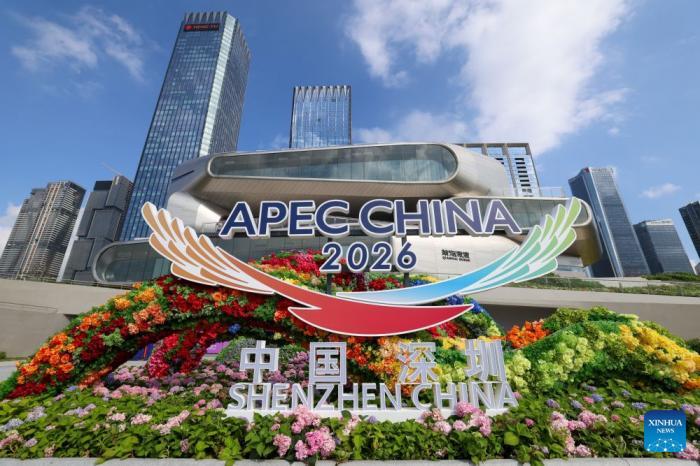
It was a fishing village four decades ago and today it is a world-renowned technology center. It is Shenzhen, the city that constitutes one of the outstanding examples of China's reform and opening-up process.
Today, the city makes headlines in media around the world. The 33rd Economic Leaders' Meeting of the Asia-Pacific Economic Cooperation Forum (APEC) will meet there on November 18th and 19th, with the theme "Building a community in the Asia-Pacific to prosper together."
Images of the arrivals of the leaders of the member economies have begun to spread in recent days, while new details of an event that is attracting international attention are becoming known.
Why is the meeting relevant? How do the themes and agreements reached at the meeting impact the rest of the world?
APEC, established in 1989, "provides a platform for dialogue and collaboration to address the region's common challenges," as noted on its website. Its decisions are reached by consensus, while the commitments undertaken by member nations are voluntary, and various forms of cooperation are employed.
Today, it brings together 21 economies at different stages of development; their participation in this mechanism underscores the importance placed on building consensus, transcending distances or differences.
The Asia-Pacific region plays an undeniably pivotal role in any effort to devise strategies with a positive global impact. It accounts for nearly half of global trade, more than 60% of global GDP, and approximately 40% of the world's population. It has been described as a key engine for global economic growth and a vital hub for cooperation.
For the third time, the Asian giant is hosting an event that transcends the framework of the event. During the Year of China in APEC, more than 300 meetings and activities have been held, with the participation of more than 10,000 representatives. This has made it possible to advance understanding in areas of common interest, laying the foundations to achieve results in trade, connectivity, digital economy and artificial intelligence.
With the motto "Building a community in Asia-Pacific to prosper together", the meeting in the coming days is a reflection of a founding premise of multilateralism: shared challenges require collectively constructed responses.
To achieve this, three priorities will be addressed: openness, innovation and cooperation, with the participation of more than a dozen leaders from the member economies.
Maintaining peace, as well as achieving cooperation and understanding despite differences, are essential not only for the region but for the rest of the world.
The announcement that Chinese President Xi Jinping will hold a meeting within the framework of the Forum, together with Russian President Vladimir Putin and US President Donald Trump, confirms the priority of dialogue as a route to resolving differences.
The Shenzhen meeting represents an opportunity to reaffirm that respect for differences and the will to cooperate are essential for development and stability. At the same time, remember that no economy has the capacity to respond to the new questions of growth and the challenges facing humanity.
That the world, in the midst of turbulence and instabilities, turns its eyes to the event that will take place in China, is confirmation of the commitment to multilateralism in the face of isolation; by the aspiration to share, instead of isolating.


