

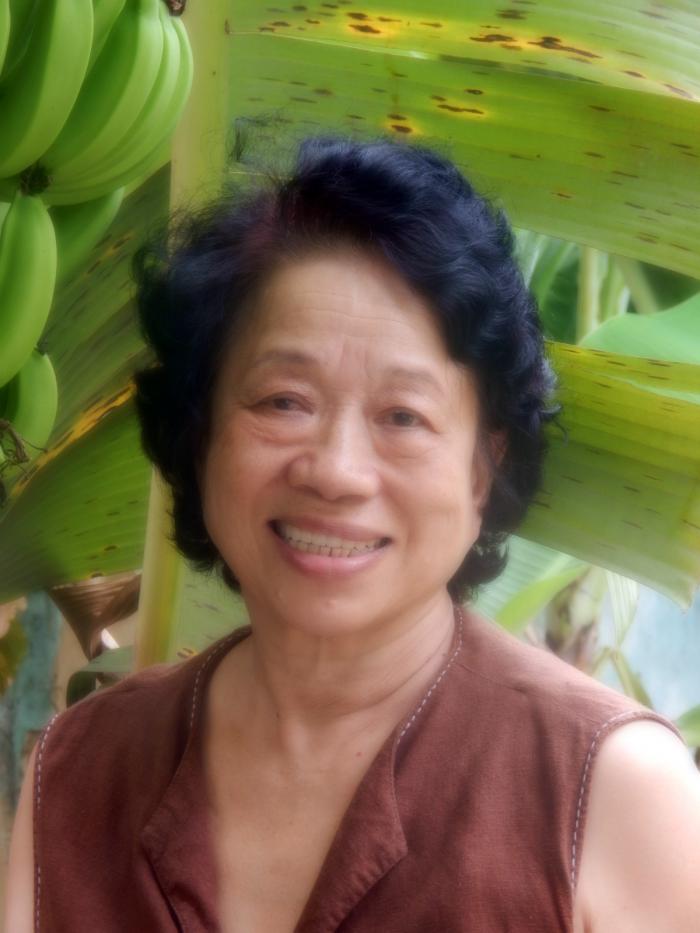
The desire to relive her experience as a student in Cuba, inspired Duong Thi Sam (Sara to Cubans) to travel over 20,000 kilometers from Vietnam to Havana to revisit her memories from the 1970s.
“That was my first trip to Latin America; we travelled via Beijing, China, then to Moscow, Russia. We saw two vast cities; I remember them well, freezing cold and grey because of the weather. On arriving in Cuba we experienced a different kind of light, a pleasant temperature and friendly people,” states Sara.
Born to Vietnamese parents and the oldest of six siblings Sara speaks good French having lived in New Caledonia where her mother and father worked.
Fearing the effects of Japanese military aggression at the end of WWII, the family returned to Vietnam, which was later invaded by the United States.
At 18 years of age, Sara was working for the Vietnam News Agency, where she became very familiar with the history of the Cuban Revolution, from January 1, 1959, led by Fidel Castro. “We reported on the horrors committed by the Fulgencio Batista dictatorship, of the victories of the Rebel Army in the Sierra Maestra, the biography of leaders Ernesto Guevara and Camilo Cienfuegos, the new government’s anti-imperialist policy and the social development programs implemented across the Caribbean island,” she notes.
The paper’s directors selected a group of 10 young people to study in Cuba to learn Spanish and expand news coverage to the rest of the world.
”I came to a country” she stated “with a great revolutionary spirit, we inhaled the enthusiasm for participating in agricultural mobilizations, voluntary work, public acts in the Plaza de la Revolución, and the commitment to want to change society for the better, hence my determination to increasingly participate in collective actions and desire to carry out activities.”
Sara remembers the young Africa, Asian and Latin Americans who lived in the comfortable houses in the neighbourhood of Siboney in the west of Havana, built by the local bourgeoisie of the 1950s and abandoned by their owners after the Revolution. These lavish chalets were integrated into the national scholarship system, at one time providing accommodations for young Cubans from other provinces studying in the capital.
”We learned Spanish in a school called Pepito Mendoza, my teacher, Professor Aida Batista, taught us grammar, editing and spelling with a focus on their uses in journalism, but she also had us recite poems by José Martí, listen to songs, practice dances and even learn to cook typical Cuban dishes. The workers who looked after the house treated us with great affection; we would talk about our countries and cultures. In the street, Cubans showed a deep fondness for the Vietnamese people as they were aware of our determination to fight for national sovereignty. I felt a sense of fraternity.”
After completing her Spanish lessons, Sara enrolled in the University of Havana to study Philosophy and Literature and received classes in the Juan M. Dihigo building, but left after two years, without graduating, as the newspaper in Vietnam requested she return to work.
“When I left in 1973 I was very emotional, I felt great sadness, having to leave behind stories and anecdotes of a period of such joy, dreams and collective action. In four years I shared with various families, made many friends and strong feelings remain planted in this land, which is why I have been obsessed with returning after I retired.”
Sara returned twice after her first trip: once in 1978 with an honorary delegation to participate in the Sixth World Festival of Youth and Students, presided by guerrilla leaders Nguyen Thi Dinh and Vo Thi Thang, and again in 1985 for a year in order to perfect her Spanish. Heavy work commitments during those periods meant that she was unable to indulge in revisiting her past as a student.
Today at over 70 years of age, she is searching for the family of Genoveba Nuñez Fernádez - also known as Bebita - in Havana; who in Sara’s student years came to regard her as a daughter also helping her deal with the trials of university life. On this occasion she has linked up with the University of Senior Citizens which provides courses for elderly residents, is partaking in neighbourhood activities organized by Committees for the Defense of the Revolution and enjoyed Pope Francis’ visit in September.
“Cubans and Vietnamese are very similar in regards to their hospitality, the open nature of the people, their cooperation and the unconditional help they offer other human beings. What is more, we have both endured difficult economic situations caused by imperial policies, therefore my message to my Caribbean people is: Keep your iron will to struggle against adversities, as the only way to advance. You must maintain the strong revolutionary sprit which characterizes you.”


