

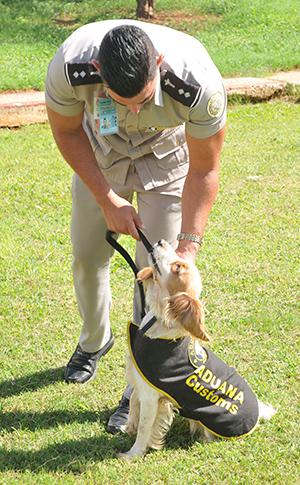
While not a fable, this story speaks of animals. Almost as old as man himself is his domestication of dogs.
Introduced into the field in recent times, canines are among the best agents in the fight against crime. Tested daily in various environments, these beloved pets appear equipped with the tenacity of Auguste Dupin, the eccentricity of Holmes or the precision of Poirot.
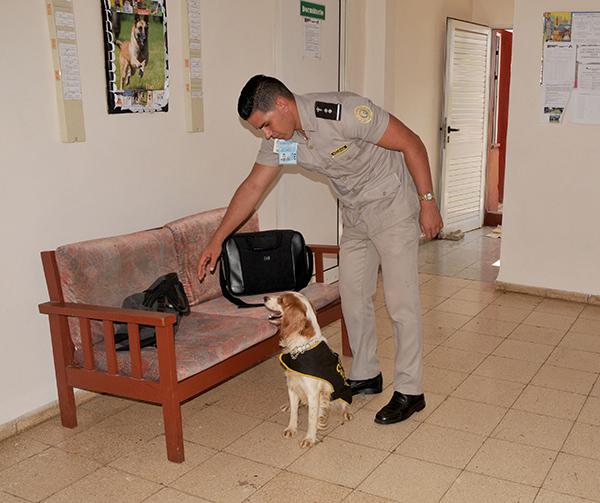
As of September 2015, over 80% of attempted border crimes were frustrated, with the help of canine units (consisting of a person and a dog) that specialize in finding drugs or explosives, part of the Department of Canine Technique at the Customs Office of José Martí International Airport in Havana.
Renier Iglesias Camejo, head of this body, created in 1982, explained that this year the fight against drug trafficking has focused on cases of detection of synthetic cannabinoids, a new form of drug manufactured in laboratories.
Speaking to Granma International, Iglesias Camejo notes that this synthetic drug constantly changes. “It consists of the dehydration of dry herbs, together with drops of chemicals and when inhaled, causes hallucinations. It is very variable. Today it is called White Cat, tomorrow they call it Ambrosia and the day after, Red Devil.”
The dog trainer also notes that there have been cases of cocaine, marijuana and heroin, but the most common is this type of drug. “It comes in packs of fruit preserves, making it barely visible in the x-ray images. They have also tried to bring it in powdered seasonings. They aim to ensure that the dog can not identify it, that’s why they mix it with strong scents such as parsley or cumin.”
He adds that between February and March, they brought together specimens of several cannabinoids to train dogs in anti-drug units at Customs, ensuring that the scents are part of their olfactory memory.
After about three years of gathering information on this new drug, all the dogs working in Customs can identify the substance and the personnel who handle them have also been trained, although it remains difficult to detect, Iglesias Camejo explains.
How does what you term the “operational life” of the dogs begin?
For more or less three months they are trained at the Academy of the Ministry of the Interior to identify explosive substances that they can detect: exogenous, penthrite and octogen. From there, the dog is able to recognize up to 300 different explosives because there is an active ingredient that is repeated in all of them. Likewise, at the National Dog Training Center the canine technicians are trained: handlers or instructors, and there are different courses for drugs and explosives specialties.
You’re one of the few technicians with a double specialization. How do canine handlers and instructors differ?
The first guides the dog in the detection of narcotics and terrorism on the border. The instructor is the one who prepares the canine units to keep them fit and operational. We have 40 of these pairings: 20 for explosives and 20 for drugs. They provide services to José Martí International Airport in Havana and that of Cayo Largo del Sur. Each person deals, exclusively, with one dog. If the handler is not there, the dog does not work, it just receives food, hygienic and health care.
As one of the few technicians specializing in both areas, do you think there are some breeds more suited than others to detect drugs or explosives?
The breed does not determine whether the dog will be used in one or another specialty. Neither one takes precedence over the other. We work with three breeds: Cocker Spaniel, Golden Retriever and Springer Spaniel. We seek out the enthusiasm of the dog. Of the three, the most motivated is the Springer as it’s also the feistiest. It has a lot of endurance and it tires less than the Labrador. While, the Spaniel’s motivation is medium to low. They are phlegmatic dogs. Likewise, the character and attitude of the handler is taken into account.
But are these the best breeds that could be used?
That depends on the area in which we are working. I can not say that these are the breeds with the best results among the canine species. The German Shepherd has the longest history in terms of tracking, substances, defense, etc.
And why don’t you use them?
Customs do not use this kind of dog due to their size. In addition, they transmit aggressiveness, they intimidate, and we work in closed rooms with travelers of all ages, from children to seniors. The dogs with which we work are more docile, more affectionate, more prone to interact with people and, therefore, make it easier for us to detect any evidence, creating the least possible inconvenience. We require the trust of the traveler and the dog.
Which qualities can not be lacking in a canine technician?
Both the handler and the dog must have certain character qualities. Among the former are patience, perseverance, motivating trust, fantasy, reward. At the same time, these features are used by the instructor. The dogs follow mimesis (they do what they see another do). The instructor provides the handler with all the tools he knows of to train the dog. The essential thing is to sow skills and strategies, based on the motivation and search capabilities the dogs have. Usually, our dogs are used to playing. Our specialty is like a hobby, because the work we do depends on a game and knowing how to reward the dog. We must reward what the dog does well at the very moment he does it. Likewise, we must correct it if it behaves incorrectly.
But there are other requirements...
We have a limit of 35 years of age for technicians, as this is the period in which men and women have fewer concerns. Today I have six women on the team, with potential for more because of new recruits. Our entry methods are very easy. We ask that the applicant establishes a game with a dog, based on the tools they have without prior job training. Thus, we observe the relationship between them. We do so in conditions similar to reality, in public places, with a lot of noise. Beyond the crowd and without losing visibility, the dog should focus and follow the commands of its owner. Our personnel also learn to master high-pitched and low voices. Together, we must make sure that the dog does not perceive situations of stress, because they acquire the character of human beings and recognize when we are happy, angry or sad.
How are the dogs that serve on the border fed?
The basis of their diet is dry food (cereals). The norms provide for 500 grams of food for the Cocker and Springer, and 600 for the Labrador. They eat 100 of these for breakfast, at 6.00 a.m., and the rest at 14.00 p.m. Those that are on operations only eat at 8.00 p.m., on returning from their day's work. The digestion of dogs is very slow and they have a limited useful period of life, from three months to eight years. They are tested to see if they have lost their olfactory abilities.
What methods do you use to work with these kinds of dogs?
Rarely do we use the mechanical method, which can be very effective, but with breeds that are truly resistant to the work, such as the German Shepherd. Sometimes such a method ends up transmitting a negative experience, as the handler uses force on the dog. It is fast and effective, but not with the breeds we use. We use better associative forms.
And how does that function in terms of working with the public?
We employ a logical sequence in the commands. We connect with them, to motivate or calm, and we give them the search command. Another way is when the dog is searching and the handler guides them through body movements. Finally, there is an exploration directed toward a single objective. The reward given is verbal, because you have to check if they have really found something.
Would you say that the Cuban canine technique is of world standard?
Yes. The dogs and personnel who staff our borders are respected in many parts of the world. We have historical results. Countries like Russia, Vietnam, Argentina and France exchange experiences with Cuba.


