

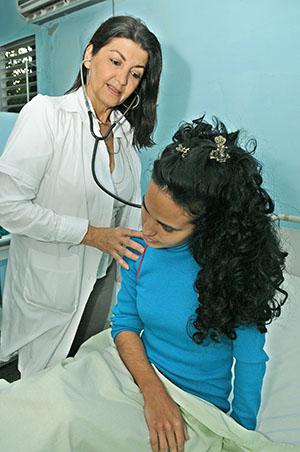
Speaking to Granma International, Cuban medical professional who have offered their services around the world describe their efforts as a rewarding privilege.
Dr. Teresa Valdés Calderín, responsible for overseeing the recruitment and training of collaborators from Havana’s Plaza de la Revolución polyclinic, and supporting their families, emphasizes that participating in an international mission is completely voluntary.
In regards to selecting collaborators, she explains that those interested first approach their area supervisors, then candidates’ ethical and professional qualities are discussed by colleagues in a union assembly, with the polyclinic’s Board of Directors making the final recommendations to municipal authorities.
She notes staff availability is taken into consideration in order to ensure that all community medical services are not negatively impacted.
Before setting off on their internationalist mission, collaborators receive training designed to prepare them for living and working in their destination country, with an emphasis on learning the native language.
Valdés Calderín notes that medical professionals who participate in the Más Médicos (More Doctors) program in Brazil are awarded a certificate in recognition of their efforts.
“When one of our compañeros assumes the sacred task of undertaking an international mission we maintain frequent contact through email and assign team mentors, responsible for visiting collaborators’ families in order to deal with any problems,” adds the General Family Medicine specialist (MGI).
Thus far, Valdés Calderín has herself participated on three missions, the first in Brazil in 1997, training personnel and helping to implement the MGI program in the state of Minas de Gerais; then in Ghana from 2001 to 2003 and most recently in Venezuela in 2007.
While offering services in the West African country she was shocked at the high level of poverty, lack of resources, poor healthcare system and intensity of the work, an experience which impacted her greatly.
“I worked in a hospital with 80 beds alongside other Cuban doctors specializing in genecology, pediatrics, internal medicine and surgery. We would start every shift with rounds and later do consultations. Patients from remote areas and suffering from serious illnesses would come to see us.
She still remembers the two Ghanaian mothers who asked her to take their newborn babies to Cuba so that they would receive a better education; and the young woman in her 30s who died as she was unable to acquire insulin for her diabetes. “Such experiences make you more committed to the humanitarian causes of the world,” she notes.
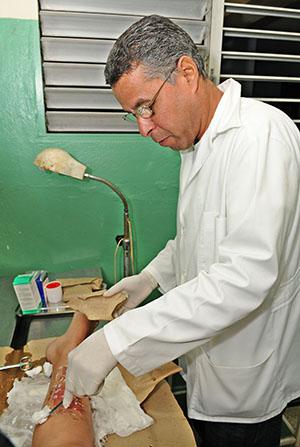
For his part, Dr. Jorge Ramón Sancristobal Díaz, a respected staff member, states that serving on international missions has taught him how vital doctors are for people in need.
Founder of the MGI program in Cuba, Sancristobal Díaz went on to apply his experiences in Brazil in 1998, and in Venezuela in 2010. He noted how primary care medicine gives him the opportunity to contribute to illness prevention within communities, treat patients in their homes, interact with people and prevent chronic diseases by advising the public on how to change their lifestyles.
Meanwhile, nursing graduate Luis Alberto Fadel Marrero appreciates the recognition he receives from his colleagues and community upon learning about his outstanding efforts in Sierra Leone to combat the Ebola epidemic.
He notes that it was difficult to explain his decision to leave for Africa to his wife and children, but that they understood, while the training he received at the Pedro Kourí Tropical Medicine Institute, supported by the World Health Organization, laid all his concerns to rest.
“During training we learned about the specifics of the virus, they taught us how to take the necessary precautions to avoid infection and we regularly practiced using the protective gear. We did a two hour simulation test in a field tent wearing our protective suits and treating hypothetical patients.”
Fadel Marrero describes the intensity of the task on arrival in the African country, with collaborators working six hour rotations caring for the sick in restricted areas. He noted that collaborators were provided with all the necessary means to avoid any problem, but suffered a great deal seeing several children die.
Finally Fadel Marrero notes that the welcome from colleagues, friends and family that met him on his return to Cuba was “the best reward we could have received.”


