

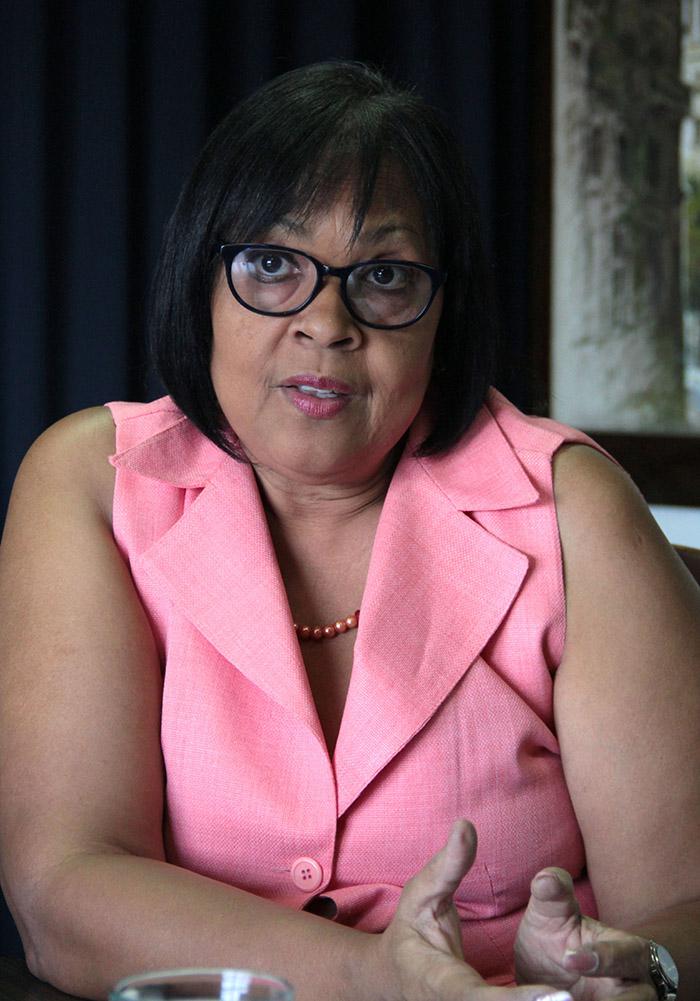
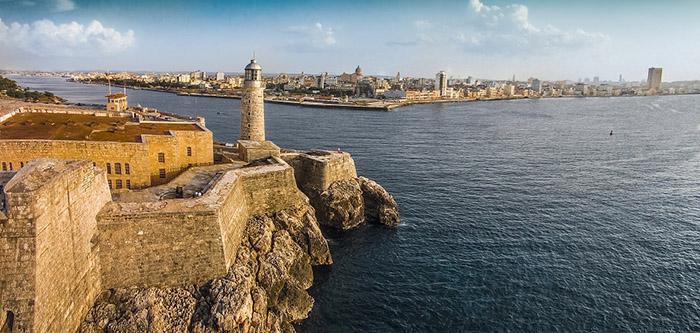
“I’m not from Havana, but Santiago de Cuba. But when you arrive in Havana, you begin to appreciate it and then you don’t want to leave. Without forgetting my roots, I recognize that the capital entices, it’s as if it captures or envelops you and that makes you love it. I am proud of it. In 2014, it was chosen as a Wonder City, but for me it already was,” Marta Hernández, president of the Havana Provincial Assembly of People's Power, told Granma International, in an exclusive interview on the 8th floor of a building which, like so many others in Old Havana, looks over the Morro Castle and the Bay.
Recalling a recent interview with the Havana City Historian, Eusebio Leal, in which he claimed he was not surprised the city was among the Seven Wonder Cities of the World, Hernández reiterated that, as part of the heritage of the nation, the capital treasures valuable tangible and intangible wealth, from its buildings, where different architectural styles converge, to the staff of the Havana City Historian's Office, such as Leal, who have done so much to rescue these assets that reflect the history of Cuba.
On June 7, as part of festivities running through Saturday, June 11, Havana officially received the title of Wonder City of the World, from the Swiss New7Wonders Foundation, on the terrace of the San Salvador de La Punta Fortress.
As part of the selection process, in the words of Hernández, the significance of Havana’s people and culture, the civic tranquility that demonstrates the state's commitment to preserving and protecting the urban environment, and the adoption of strategies which require that state agencies and institutions and individuals care for what has been created in the city, were all taken into consideration.
According to the official, an organized, friendly, developing city, in which modernity does not compete with tradition, nor the present with the past, must be bequeathed to future generations. In this sense, one of the Party Guidelines addresses urban planning: “The government is working hard to implement reorganization that will eliminate violations, better arrange investment processes and achieve greater harmony.”
What was the government’s responsibility in the naming of Havana as a Wonder City?
We were made aware of what the New7Wonders Foundation was promoting through the Ministry of Tourism. With the help of the City Historian’s Office and other bodies, we focused on promoting what was being done and organizing the participation of our citizens in the vote, in which over 200 countries finally participated.
What would you highlight regarding this vote, which became a participatory exercise?
The European organizers themselves have defined it as a global democratic exercise, where the world provided its view by voting. Social networks and mobile phones allowed people to share what they thought of the city and its authentic values.
As a government, we know first hand about this kind of democratic practice as it constitutes our working method. There is nothing extraordinary about it for us, but we appreciate it, as it includes what many different people think and that provides more validity. It indicates that Cuba is known, respected and admired. I think it is recognition of the Cuban identity, of an island that has managed to establish itself despite thousands of obstacles, and whose people have a practice of struggle, resistance and the will to move forward.
How does this distinction fit in with the celebrations for the 500th anniversary of the founding of Havana?
It is an additional element to the work of preservation which has been carried out for a long time, as it comes at a stage where we are preparing the festivities for the 500th anniversary of the founding of the Villa de San Cristóbal de La Habana, which will occur in November 2019. We are currently presenting proposals for consultation to institutions, organizations and personalities.
We hope to reach this half millennium with a city that will display all its elegance, but that still requires years of recovery work, to revive large parks and avenues, restore buildings, etc. There is an agreed strategy to provide long-term continuity to the commitment to putting an end to the deterioration experienced in installations and areas of the city.
It also relates to what was approved at the Seventh Congress of the Communist Party of Cuba about promoting a sustainable, viable society, based precisely on the welfare of human beings.
It is also necessary to talk of the capital as a center of scientific and industrial development, bringing together human talent…
We are the pioneers of that which Comandante en Jefe Fidel Castro encouraged, of that peaceful coexistence with nature, which has given birth to many famous scientists and great discoveries. The city’s scientific complex is still evolving and has been a strong source of what is being done in the country. To offer just one example, the Center for Genetic Engineering and Biotechnology has branches across the country.
Likewise, Havana is the epicenter of the contributions science makes to other sectors such as the economy, health, agriculture, etc. Something that distinguishes everything is that this was achieved through research and human resource excellence. There are many prominent medical training institutes, providing services inside and outside the capital, and the same goes with culture.
While there is cultural talent throughout the country, initiatives and the participation of people who support and engage in this sphere are guided by the capital. The riches can be seen in all fields. If we look at the productive sphere, we find that it is a distinctly industrial site, where we have unique factories and industries in the country, in which technicians and professionals from other places have been trained. Progress extends thanks to this.
We have a responsibility to guarantee a series of services, resources and products to other provinces. The city comprises almost 40% of national production and this means that the efforts of workers and officials to improve economic performance in Havana are based on a commitment to Cuba.
Although the port of Havana is today changing its function, it plays and will continue to play a major role in Cuban trade. We continue to be committed to the future growth of a creative, eminently tourist city. Culture is part of the Cuban nation’s rise, and therefore is fundamental to the galas to celebrate the title of Wonder City.
The festivities are guided by the artistic expressions that we are renowned for: music, dance, visual arts. Similarly, prestigious Havana universities will be invaded, there is space for sport, and this is being done with the massive participation of the population.
Havana is home to a fifth of all Cubans, whether habaneros or people who have migrated here. Do you believe the city is representative of Cuba? What distinguishes the diverse community that lives in the capital?
On noting that this is the capital of all Cubans, we encompass this concept. Here live not only people originally from the city, but from every corner of the island. Wherever we go, we find the people of Cuba. It is an honor to know that in Havana there is everything that represents Cubans and that in countless activities and events the rest of the territories are necessarily included.
In parallel, we aim to strengthen identity and a sense of belonging, not from a regionalist point of view, but based on the essence of Cuban identity. There are values to be strengthened, the same which many argue have been lost or are in crisis, but the main thing is that people notice and appreciate what is being done.
It is a city in which one sees that their aspirations can be achieved. We are talking about real possibilities and conditions, but we must create more obligations and responsible citizen attitudes. This is one of the objectives for the 500th anniversary: to encourage better educational work and this patriotic feeling that safeguards all that is Havana and Cuba.
Undoubtedly, Havana is the capital of peace. We receive many friends and that's another sign of the qualities of our people. There's the medical, cultural, scientific solidarity we possess. The habanero represents that humanist, warm Cuban, who helps and shares. Sometimes we see neighbors helping each other as if they were family.
Havana continues to be Havana, and it is not just now that it is becoming known. We did not just recently discover that it is a great city, an example for Latin America and the world. The priority is to preserve our identity from banality and use our true culture as a shield, as explained by Fidel.
To paraphrase poet Fina García Marruz - could it be its openness that is the secret of Havana? Is that why this beautiful city has the profile of a bird? Undeniably, Havana is, and will be, a triumphant city of unequal angles.


