

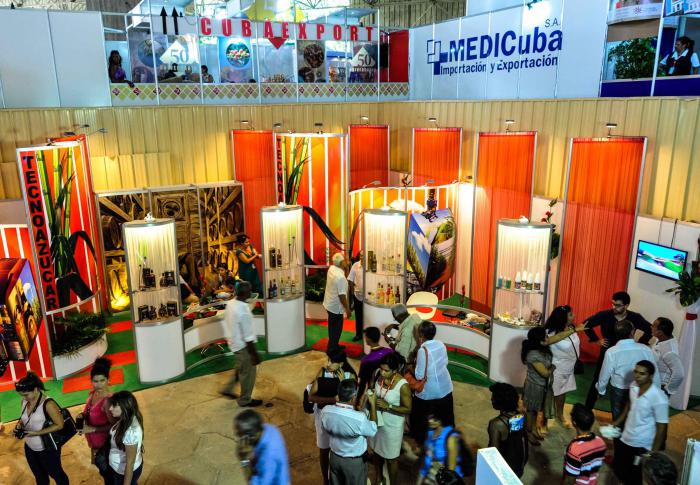
Within the process of the updating of the Cuban economic model, attracting foreign capital is the most strategic and significant aspect. Without jeopardizing national sovereignty, the Foreign Investment Law no.118, which came into force on June 28, 2014, seeks primarily to diversify export markets, ensure access to advanced technologies, and, of course, obtain external financing.
In the longer term, the legislation aims to create new sources of employment; expand administrative methods; substitute imports; develop production chains; and change the country’s energy matrix, with greater use of renewable energy sources.
Given this context, we approached what we could call the “lifeline” of the Cuban business community in terms of international economic relations: the Chamber of Commerce of the Republic of Cuba (CCRC).
Through its structures, this organization has had a fundamental objective since its founding in 1963: to support the internationalization of Cuban enterprise.
Granma International spoke exclusively to Orlando Hernández Guillén, president of the CCRC since 2014, who described some of the aspects currently most influencing the development of the domestic economy.
What structures, services and strategies are available to the CCRC as a means to promote the Cuban economy in the world of international economic relations?
Although there are other mechanisms, we should note the existence of a Directorate of International Relations, which is responsible for establishing cooperative ties with foreign counterparts and organizing trade forums, foreign business activities in Cuba, and Cuban missions which travel to different markets to promote our interests. It also helps boost trade relations and address weaknesses or problems in bilateral business committees.
There is also the Department of Fairs and Exhibitions, which organizes Cuba’s participation in international events and determines, through a Chamber Plan, where Cuba will be present. In addition, it advises Cuban representatives and supports the island’s international fair events such as the Havana International Trade Fair; the Agricultural Fair; the International Tourism Fair; the International Book Fair; those on crafts; and other events of interest to the national economy.
To assist Cuban enterprises, with the elements that we believe may be of interest for their preparation and work with international markets, we have a Department of Information and Publications and, at the same time, there is one (a department) of Associates, which includes Cuban companies by sector across nine divisions, such as the pharmaceutical industry, services, construction, culture, information technology, transportation. These divisions identify interests, objectives, difficulties. They have an executive secretary and dictate their needs for improvement. Courses and seminars are organized based on these ideas. The greatest number of associates are from the industrial sector. At the close of 2015, the Chamber had a membership of about 703 companies.
Another important task of the Chamber relates to helping Cuban businesses with foreign trade and foreign investment. For this, since 2014 there has been a group responsible for promoting Cuba as an investment destination. Everything is based on the needs of the national economy and the business dealing with the exterior, whether to sell, buy or partner. To facilitate this work, as companies are scattered throughout the national territory, delegations were created in Villa Clara, Camagüey, Holguín and Santiago de Cuba.
What would you highlight as Cuba’s main potential as regards the development of the business sector?
Cuba has potential as a destination for foreign investment and for three years this has been reflected in the Portfolio of Business Opportunities, which in its latest edition featured more than 320 projects proposed by Cuban enterprises involving fifteen sectors, with a value in excess of approximately 8 billion dollars.
There are also the possibilities of Cuba as an exporter of quality products among which rum and tobacco stand out, and its important developments in the pharmaceutical industry, services, biotechnology, accompanied by a highly skilled workforce. Although medical services are the best known, they are not the only professional services we export. On the other hand, there are attractions such as the preparation of the Cuban workforce, safety and reliability, which make the island a trusted market for business.
Is the main objective of the CCRC still to promote the development of Cuban associated enterprises? And if so, why?
What we do is maintain constant interaction with companies to find out what they need or are interested in and we guide them toward knowledge and events that can help. We also seek to identify where Cuban businesses require specialization and, based on the agreements we have with more than 150 chambers and promotional institutions across the world, we bring experts to contribute to their training. When we bring foreign businesspeople over, we organize for them to meet with potential counterparts in Cuba.
Of the more than three thousand companies with which Cuba trades, I will mention some of those operating for the longest time in Cuba, from the sectors or countries most represented, etc.
By country, there are renowned companies that even have a symbolic significance as they have been in Cuba a long time. In the case of China there are large companies, such as that which buys our sugar, those that buy nickel, that which is building the port of Santiago de Cuba, or the investor China Enterprises, which is moving into tourism. Venezuela is another major partner, from which PDVSA should be mentioned, one of the leading companies in Latin America and with an active presence in Cuba, as a supplier of fuel and an investor in the Cienfuegos refinery.
In addition, the Canadian (firm) Sherritt, some entities from Brazil, and Pernod Ricard from France.
How is the exploratory approach of the U.S. business sector in Cuba progressing?
As you say, it’s just an exploratory process. Many U.S. businesspeople from different organizations and regions such as Arkansas, Texas, Louisiana, New York, have come. Each political visit is accompanied by businesspeople. There is great interest in Cuba, in learning about business in Cuba, what Cuba has to offer, what interest can be found in the Cuban market. But everything stops there. There is no possibility of doing more due to the economic, commercial and financial blockade of the United States against Cuba.
The modifications made by the current administration of President Barack Obama, through executive measures, to blockade regulations allow for little or almost no activity. The commercial outlook remains virtually the same as before December 17, 2014.
Why is the United States a natural market for Cuba? How much would be possible without the blockade?
The concept of a country’s natural market is described in any text on international economic relations and foreign trade. Geographical proximity, history and complementarity with the other market are factors that are taken into account, beyond agreements that can be made to make trade possible. These factors make strong trade between the countries possible under normal conditions.
Before the North American Free Trade Agreement, this occurred between Canada and the United States or between Mexico and the United States. If we go back to the last stage of the colonial period in Cuba and the neocolonial period, we find that the United States was the main trading partner of Cuba. Today the conditions for this are still created.
The proximity to the United States would undoubtedly allow many Cuban products to go there and U.S. imports to arrive on the island. What happened before the triumph of the Revolution? There was little storage infrastructure in Cuba. Why? Because the products were kept in the United States and in one hour could be shipped to Cuba.
Do you not think that the trade which would flow between the U.S. and Cuba if the blockade were lifted could be detrimental to the island?
It would not be detrimental. We would just have to be cautious. If normal relations between the two nations were restored today, obviously, the natural conditions of which we spoke would allow for a strong flow of trade.
How many U.S. tourists would come? Two or three million?
Today, lots of U.S. citizens come, although they can not enter as tourists.
Moreover, the United States is the main market for tobacco and rum in the world and those are two of our main export items.
But under no circumstances would Cuba depend absolutely on that market or any other. Today we have a universe of trade relations with more than three thousand companies in a hundred countries. We will always maintain this diversified relationship with Europe, Asia, Latin America and, if possible, also with the United States, but never as a relationship of dependency.
What role does the Havana International Trade Fair play in the economic improvement of the country? What distinguishes this event?
The Havana Fair is important for Cuba to promote national interests in international economic relations.
It is an event to which official and high-level trade delegations come and, therefore, constitutes a significant moment for medium and long-term negotiations with foreign representatives.
Even ministers and vice presidents from around the world come to the Fair. It provides the domestic economy with the possibility of a quick look at what the world has to offer to industry, transport and other Cuban sectors. It also offers a space for domestic enterprises to present, before three or four thousand businesspeople, the most advanced of its products, interests and needs.
The Fair boosts foreign capital in Cuba, by launching the Portfolio of Business Opportunities.
Could you provide some details regarding the upcoming Havana International Trade Fair?
Although I still can’t reveal much, I would like to emphasize that the upcoming Havana Fair will see an Investment Forum in session over two days, which will be based on the proposals, policies and needs of Cuba in terms of business, to attract investors and, beforehand, arrange meetings with their Cuban counterparts.
It will be an opportunity for interaction with partners, with authorities, etc., with an impact on the buying and selling activity of the country. As is usual, the Cuban Pavilion will host the Chamber of Commerce. We hope it will be a big fair, exceeding that of last year which was the best so far.
How is the CCRC adapting to a world dominated by information technology and telecommunications? To what extent do you believe technological development influences the efficiency and effectiveness of business?
If we do not adapt to a globalized world we will lose everything. There is no way forward in anything I have mentioned so far if new technologies are not actively used. These are needed to communicate, to search for information and exchange, to present the information that one would want to emphasize.
Hence the Chamber has a website and is automating records of the institution regarding exporting and importing companies, travel agencies, enterprises associated with the Chamber and branches and agents of foreign commercial companies. However, there remains much to be done.
In which sectors or markets are better results required? Which are those that have not yet been sufficiently explored or exploited?
Cuba has yet to achieve the objectives that have been identified in terms of the assimilation of foreign capital. It has been publicly stated that the savings that the Cuban economy requires to stabilize growth between five and seven percent a year must have additional, external sources, of more than two billion dollars and we have not reached this amount yet.
The investments that Cuba brings to the economy, the Mariel Special Development Zone, should increase the rate of accumulation of the economy to achieve sustained growth. We must also work for the export of Cuban products with higher added value, such as those derived from biotechnology and related knowledge, which can provide higher income. Another pending task is to bring down the U.S. blockade, of serious harm to our nation.
What benefits would you highlight of the Foreign Investment Law implemented in Cuba?
It is a law that was worked on and the environment was analyzed to insert Cuba as a potential market for foreign investment in the area of Latin America.
It was designed to be attractive to businesspeople and companies given the guarantees offered through low taxation, utilities, executive salaries, etc. To this we add the potential of which we spoke, which is not included in the law, but specific to the country.
Has the CCRC planned to work with cooperatives?
Yes, the Chamber has to adapt because it can not be a static body. To the extent that the field of the Chamber, which is the Cuban business world, changes, the Chamber will do so too. The issue of cooperatives and small and medium-sized state enterprises will bring some of those changes.
What is the greatest challenge and the biggest concern of the CCRC today?
To fully carry out our goals with maximum efficiency, which is to serve Cuban enterprises and for Cuban enterprises to find a reference for their daily work in the Chamber, according to national interests and contact with the exterior. It is our duty to serve the country’s trade policy and contribute to enhancing the image of Cuba.


