

A sixteen year old Brazilian girl was raped by 30 men in Río de Janeiro in late May 2016. The video of the attack was posted on Twitter and is being investigated as a cyber crime. The rape was organized by the victim’s ex-boyfriend as payback for supposedly cheating on him. Another young girl in Argentina was stabbed 49 times by her former partner after ending their relationship. Meanwhile Marina Menegazzo and María José Conique, also from Argentina, were drugged with benzodiazepine and murdered while on holiday in the costal town of Montañita in Ecuador. In mid-October the rape and murder of 16 year old Lucía Pérez, who was impaled with a wooden spike, shocked Argentine society.
The aforementioned cases are the most extreme examples of murders or violence committed against women for just one reason: their gender. Although some of these examples are more common than others, all form part of a phenomenon known as femicide, which was been spreading across the world and become part of daily life in Latin America.
Listed below are the countries with the highest rates of femicide in the region.
IN LATIN AMERICA
EL SALVADOR
8.6% of the 6,656 murders registered by the state prosecution were identified as acts of femicide.
37 cases were successfully prosecuted.
20-30 years is the sentencing range, while the most serious cases can see prison terms of between 35-40 years.
All murders are linked to intra-familial abuse.
GUATEMALA
846 women were murdered in a population of just over 15 million in 2014, one of the highest rates in the region.
In 2008 this was one of the first countries to officially recognize femicide as a crime.
BRAZIL
Every 11 minutes a woman is raped, almost always by more than two men.
10% of cases are reported.
States with the highest rape rates:
Roraima, Espírito Santo, Alagoas, Goiás and Acre.
63,090 women were killed in the first 10 months of 2015.
Former President Dilma Rousseff approved the Femicide Law, raising prison sentences from 12 to 30 years.
MEXICO
Over 300 women are raped while drugged and unconscious each year, in Mexico City alone.
7,185 women have been forcibly disappeared.
80% of migrant women and girls from Central America were raped on their way to Mexico in 2014.
24% of cases are investigated by authorities, while only 1.6% make it to trial.
The majority of victims are migrant women traveling through Mexico to reach the United States.
ARGENTINA
2,041 femicides between 2008 and 2015. All victims were girls or adolescents.
Every 30 hours a woman is murdered. The majority by their partners or ex-partners.
October 4, 2003, the La Casa del Encuentro was founded, an NGO and feminist movement for women’s rights.
November 2012, the Chamber of Deputies approved a law that punishes gender crimes with life imprisonment.
UN figures
25 countries have the highest rates of femicide in the world.
14 of these countries are located in Latin America and the Caribbean.
98% of crimes go unpunished
In the majority of cases, rape, harassment, psychological and physical abuse go unreported due to fear, shame, or “love.”
WHAT IS GENDER-BASED VIOLENCE?
“Any behavior, act or omission, which either directly or indirectly, both in the public and private spheres, based on an unequal relationship of power, affects women/girl’s lives, freedom, dignity, physical, psychological, sexual, economic or patrimonial integrity, as well as their personal safety.” (According to Argentine law)
It comes in many forms:
Physical: Violence used against a woman’s body causing pain, injury or the risk of causing it and any other form of mistreatment or aggression affecting her physical integrity.
Economic and property: Any violence that aims to undermine a woman’s economic and property resources, through the disruption of possession, tenure or ownership of her assets, the wrongful loss, removal, destruction, retention or diversion of objects, working equipment, personal documents, assets, equity and property rights.
Sexual: Any action that entails the violation of a woman’s right to freely decide on her sexual and reproductive life in all its forms, with or without genital penetration, through threat, coercion, the use of physical force or intimidation.
Symbolic: Violence that transmits and reproduces domination, inequality and discrimination in social relations, by naturalizing the subordination of women in society, through stereotyped patterns, messages, values, icons or signs.
Psychological: Violence that causes emotional harm and affects self-esteem or harms and disrupts a woman’s full personal development or tries to humiliate or control her actions, behavior, beliefs and decisions, through threats, harassment, bullying, restriction, humiliation, dishonor, discredit, manipulation or isolation.
Social networks
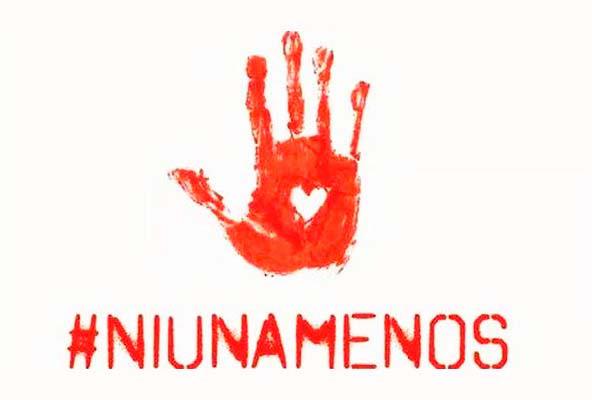
The #NiUnaMenos (Not one woman less) campaign urges people to change their profile pictures to denounce gender-violence.
It is active across networks such as Facebook, Twitter and Whatsapp
It was launched in Argentina by a group of journalists, activists and artists.
Mass protests were held on June 3 2015, in the Plaza del Congreso, Buenos Aires, and hundreds of squares across the country in support of the #NiUnaMenos campaign.


