

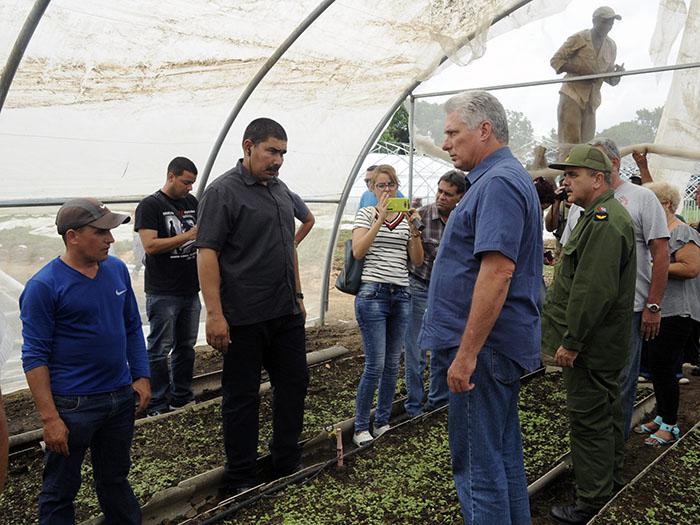
PINAR DEL RÍO.– Miguel Díaz-Canel Bermúdez, President of Cuba’s Councils of State and Ministers, on the afternoon of October 10, toured areas most affected by Hurricane Michael, where he conversed with the population, taking an interest in damage to tobacco industry infrastructure.
The head of state was able to confirm recovery efforts underway, with residents immersed in repairing storm damage as quickly as possible.
Ministry of Agriculture leaders and workers, in the municipalities of Pinar del Río and San Juan y Martínez, explained to the President the work being done to try and save more than 31,000 beds of tobacco seedlings damaged, and repair several dozen greenhouses.
Díaz-Canel commended the speed with which efforts to repair facilities had begun, regardless of the fact that October 10 was a national holiday.
“The people are working as if it were a normal day,” he noted.
He spoke with workers and the population residing around the two batteries of greenhouses he visited, discussing steps taken to restore electrical power, and asking about the condition of their homes, the provision of basic services and supplies, including the delivery of bread.
Leading the government delegation that included First Vice President Salvador Valdés Mesa and the Council of Ministers, Díaz-Canel presided a work meeting, in which he received updated information on the situation from the Provincial Civil Defense Council.
Reported were preliminary evaluations of the damage, which indicated that 1,080 dwellings were affected, and 92% of clients initially without electricity, which led to the shutdown of 140 of the province’s 179 water pumping stations.
Among the measures adopted to support the recovery, Minister of Construction
René Mesa Villafaña reported that an adequate number of complete roofing kits have been assigned to the province to repair the 120 roofs destroyed, and 15,000 fibrocement panels to address partial roof damage.
On this issue, Díaz-Canel noted that the 2019 Economic Plan must reflect the reality that Pinar del Río is the province most often hit by hurricanes, and ways must be found to accelerate recovery efforts.
Alejandro Gil Fernández, minister of Economy and Planning, confirmed that 570 cubic meters of wood are guaranteed for the repair of homes and fishing industry facilities on the shoreline, specifically La Coloma Industrial Fishing Enterprise.
He added that, to support the removal of solid waste, 150 containers and eight large wheeled receptacles are being delivered to the province.
Deputy Minister of Finances and Prices, Meisi Bolaños, reported that, using state budget reserves, the province will be allocated an amount greater than a million pesos to subsidize repairs of facilities damaged by Michael’s fury.
As a part of the solidarity being shown Pinar del Río, reported was the news that five contingents of electrical workers from other provinces are supporting repair of the electrical system, and that 64% of clients had their power restored, as of October 10.
First Vice President Salvador Valdés Mesa also visited areas affected by the storm in the municipalities of Sandino and Guane, two of the most severely impacted.
In the first, he participated in a Municipal Defense Council meeting in which he learned of the extent of damage, and alternatives being employed to ensure the availability of potable water and the distribution of food supplies to the population.
Later he visited the XX Aniversario Cuartel Moncada School, the largest educational center in the area, with a student body of close to 900.
Valdés Mesa, also a Political Bureau member, dialogued with teachers working here to get the school cleaned-up and repaired, in order to resume classes next week.
Other stops on his itinerary included the Sandino dairy products plant, where milk from the western portion of the province is processed, and the Isabel Rubio People’s Council in the municipality of Guane.
Here, local authorities reported that 47 families remain sheltered in the homes of friends and family, after being evacuated due to the cresting Cuyaguateje River, which continues to overflow its banks.
The First Vice President noted that before the storm had passed San Antonio Cape on the island’s western tip, the country’s central government was taking steps to support Pinar del Río and other affected areas, saying, “The province is not going to be alone in the recovery.”


