

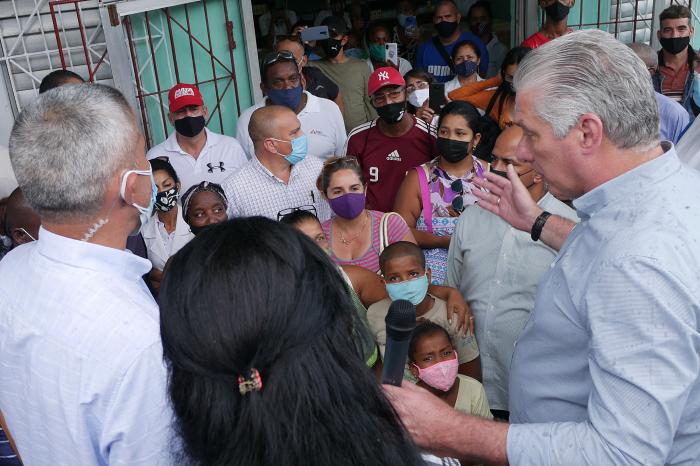
Communist Party of Cuba Central Committee First Secretary and President of the Republic Miguel Díaz-Canel Bermúdez led a February 7 meeting at the Palace of the Revolution to review social programs promoted by Comandante en Jefe Fidel Castro Ruz with special determination at the beginning of the 21st century, a humanist work that continues to this day.
Díaz-Canel referred to a detailed survey the country's leadership has undertaken of each of these programs, some aimed at a local level or an existing situation, while others have evolved to be assimilated by ministries related to the work being done.
"It seems to us that some kind of updating or revitalization is needed," President Díaz-Canel Bermúdez stated, adding that some programs have slowed down over time while others have advanced at a steady pace. He spoke in these terms, without losing sight of the fact that a group of programs have lost some momentum in their execution, while others need follow-up: "What we want is to reach a stage in analyzing social work problems and work in neighborhoods, attention to people with some disadvantages in our society,” so we can reach a moment of revitalization in order to move forward.” he said.
A brief summary on the programs, projections, ideas and tasks conceived by the historic leader of the Revolution Fidel Castro was presented to begin the meeting, also attended by Political Bureau members Prime Minister Manuel Marrero Cruz, Vice President of the Republic Salvador Valdés Mesa and Party Secretary of Organization Roberto Morales Ojeda.
Minister of Labor and Social Security Marta Elena Feitó Cabrera addressed the meeting as well, to discuss, among other topics, social prevention and attention to vulnerabilities, and also shared concepts that have been defined by academics.
The Minister explained that these new concepts have been prepared together with experts and deal with the definition of human development, equity and social transformation in order to focus all actions and design strategies to move forward with this work. Regarding vulnerability, for example, the Minister emphasized that it is a multidimensional and complex situation with a relative nature: "No person is vulnerable per se," she said: someone is not vulnerable because they are 60 years of age or older, or because they have three or more children, or because they are part of a single-parent household. Scholars insist on speaking of situations of vulnerability, given that the analysis and identification of each case is defined by the degree of "resilience," the capacity of individuals, families and communities to recover and take on adverse situations or not.
The Minister also warned that social work cannot be improvised: it requires preparation to determine how to implement a designed plan, especially at the provincial or municipal level. This work is not often understood in its transformative function, and is frequently viewed in terms of complying with instructions or submitting reports. Special attention should be paid to alliances with other social actors and connecting research to action, she added.
The programs that have been designed to permeate and impact municipalities more efficiently, as President Díaz-Canel has said. These programs concern entities such as the Cuban Institute of Radio and Television (ICRT); the National Institute of Sports, Physical Education and Recreation (INDER); the Ministry of Communications; the Ministry of Tourism; the Ministry of Science, Technology and Environment (Citma); the Ministry of the Revolutionary Armed Forces (FAR); the Ministry of Public Health; the Ministry of Education; the Ministry of Higher Education; the Ministry of Culture; the Ministry of the Interior (MININT); and the Communist Party of Cuba.
The President of the Republic spoke about the need to systematically supervise ongoing programs. "In the case of social issues related to situations of vulnerability, I think we must consider how many people we are moving out of the situation of vulnerability." In this regard, he referred to the value of preparing monthly balance sheets that can contribute to an annual summary, in order to determine the efficiency and the impact of these programs.
The population must be informed of the progress of the programs, Diaz-Canel Bermudez reiterated, calling for computerizing each of these programs, which many people think have come to a halt these days.
He stressed the importance of devoting time to these programs because they are the social basis of the Revolution, and demonstrate the true humanist vocation of the Revolution, giving continuity to the legacy of the historic leader of the Revolution Fidel Castro’s thinking.
They are the incarnation of the ideal of Cuban socialism: achieving the greatest possible justice. These programs are focused on social justice, he said.
Toward the end of the meeting, Díaz-Canel Bermúdez recommended some guidelines to advance in these social programs, reiterating the importance of returning to the intensive training of social workers; promoting the best of our music through modern formats; updating the subjects taught via “University for All” television programs; returning to teaching chess in schools; recovering the competitive sports system; and updating the training provided computer teachers.
In total consonance with Fidel Castro's thinking, the President made reference to educational work in the country's penitentiary system; the development of medical genetics; efforts to ensure that every young person is engaged in either study or work; relaunching the Family Library in digital format; seeking new ways to train Art Instructors; and developing the Cuban Encyclopedia, "1,000 questions-1,000 answers," available in digital format, among other tasks at hand.
"Let's get to work," Díaz-Canel urged those present, and set the tone for a gigantic but urgent effort that addresses both the physical and the spiritual growth of the Cuban people.


