

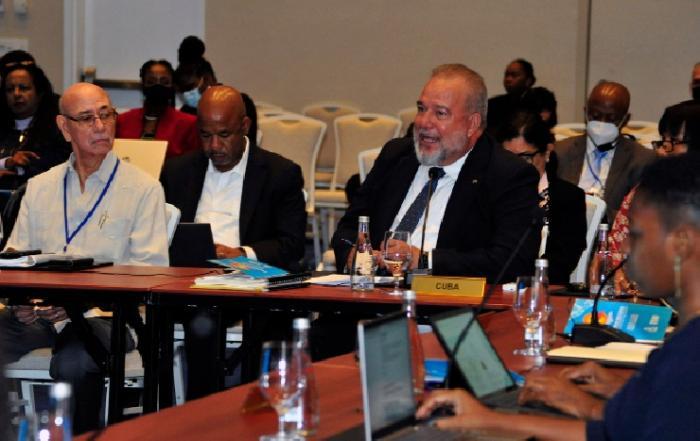
Nassau, The Bahamas. - The member of the Political Bureau and Prime Minister, Manuel Marrero Cruz ratified Cuba’s decision to spare no effort in the fight against climate change and for the development of the Caribbean countries; as well as Cuba’s will to support all Caribbean nations in this and in any other issue in which Cuba’s help may be required.
He stated this while speaking at the high-level dialogue of the First Regional Meeting of Heads of Government of the Caribbean, which ran until August 18 and served as preparation for the 27th Conference of the Parties to the United Nations Framework Convention on Climate Change (COP27).
From the Nassau Convention Center, where the event is taking place, Marrero Cruz also reiterated the conviction that a better world is possible if all developing countries make progress in solving our problems firmly and in our own terms.
In his speech, he thanked the statements of support from the Caribbean Community and several States of the region in response to the major fire at the Supertanker Base in Matanzas, and specially highlighted the solidarity of Venezuela and Mexico.
The current climate crisis "demands more ambitious commitments on the part of all States, first and foremost the developed ones. It is essential to put an end to the irrational production and consumption patterns of capitalism,” said Marrero Cruz.
Regarding Cuba, he reported that in September 2020 it presented an update of the Nationally Determined Contribution, with higher commitments up to 2030, among them the increase of up to 24% of electricity generation from the use of renewable energies, and the increase of forest cover by 33%.
"In spite of the serious limitations derived from the blockade, intensified to extreme levels, Cuba has made progress," the Head of Government acknowledged. Although the achievement of these goals and other more ambitious ones also depends on the availability of the necessary resources to support national efforts.
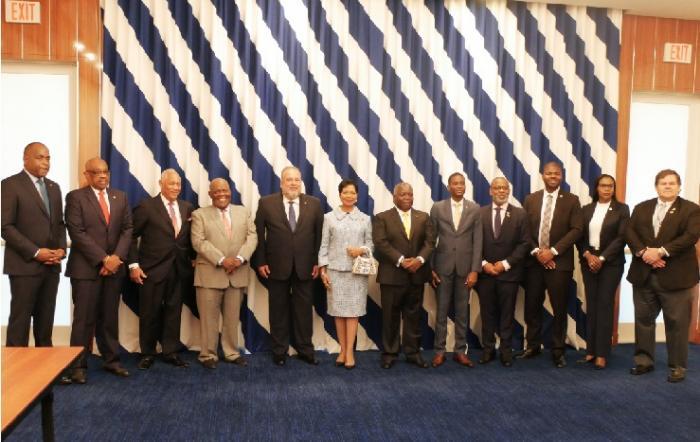
In this context, he said, we have begun to explore the potential of the carbon market, an issue in which Cuba should strengthen its regional capacities.
Later, in a second intervention focused specifically on climate change adaptation, the Prime Minister said that this is a priority, a matter of survival, particularly for small island developing nations.
Before the audience, he explained the particularities of the Tarea Vida, the Cuban State's plan to confront climate change, and insisted on the need to advance in concrete actions, "because what we do not do today we may regret tomorrow, and we are talking about the future of our nations and about saving lives."
The Prime Minister of the Commonwealth of the Bahamas Philip Davis had already called for integration and the search for common positions among all Caribbean countries at the opening ceremony. Development "requires collective action. Together we are stronger,” he said.
CUBA, THE ISLAND OF SOLIDARITY
In the context of the regional meeting, the Cuban Head of Government held fraternal meetings with the Prime Minister of the Commonwealth of Dominica Roosevelt Skerrit; the Prime Minister of Barbados Mia Mottley; and the Bahamian Minister of Education Glenys Hanna-Martin.
In each of the exchanges were discussed solidarity, condemnation of the blockade, gratitude for each and every show of support in the wake of the Matanzas disaster, how much the Caribbean unites us and the enduring legacy of the Commander-in-Chief.
Roosevelt Skerrit, who is also Minister of Finance, Resilience, Economic Affairs and other portfolios, reiterated his country's "unwavering commitment" to Cuba: "We are friends and we are at your service in any aspect we can contribute."
For his part, Marrero Cruz expressed his country's willingness to continue strengthening bilateral relations and to expand the subscribed cooperation agreements.” We must now be more united than ever, integrate and support each other,” he said.
“If we have learned anything, it is that "there are no weapons against the firmness and resistance of a people. And when that is assured, one is convinced that victory is possible", the Cuban Prime Minister reflected.
“We cannot give in, aware that the destiny of a country can only be decided by the majority of its children,” agreed Roosevelt Skerrit.
Almost at the end of the first day, Marrero Cruz spoke with the Prime Minister of Barbados Mia Mottley who had just arrived at the event, and who considered it a pleasure that this meeting marked the beginning of her agenda.
In the year that marks the 50th anniversary of the establishment of diplomatic relations between the two countries, Mottley pointed out that cooperation, brotherhood, political dialogue at the highest levels have marked the relations thus far, and expressed her interest in strengthening ties in all areas that can contribute to the improvement of the economies of Cuba and Barbados.
"I believe in deep friendship," emphasized the Prime Minister, while highlighting the work of Cuban doctors in the fight against COVID-19, and how much they have helped her people.
Another emotional meeting was held with the Minister of Education of the Commonwealth of The Bahamas Glenys Hanna-Marti who expressed her recognition and admiration for Cuba.
She inquired about the structure of the educational system in Cuba, praised the work of collaborators on Bahamian soil and placed special emphasis on the role of Cuban women in the country's transformations.
In the Caribbean, there has always been a common denominator: support and respect for Cuba, the Prime Minister said. History has shown what we can do together, especially in the area of cooperation, she added.
They also discussed education and the challenges facing the sector. They both agreed on the need to defend everything that identifies and defines us as a nation.
A country has to ponder the teaching of its History, its culture, because the great powers pretend that citizens forget their roots and that is what must be preserved, summarized the Head of Government.


