

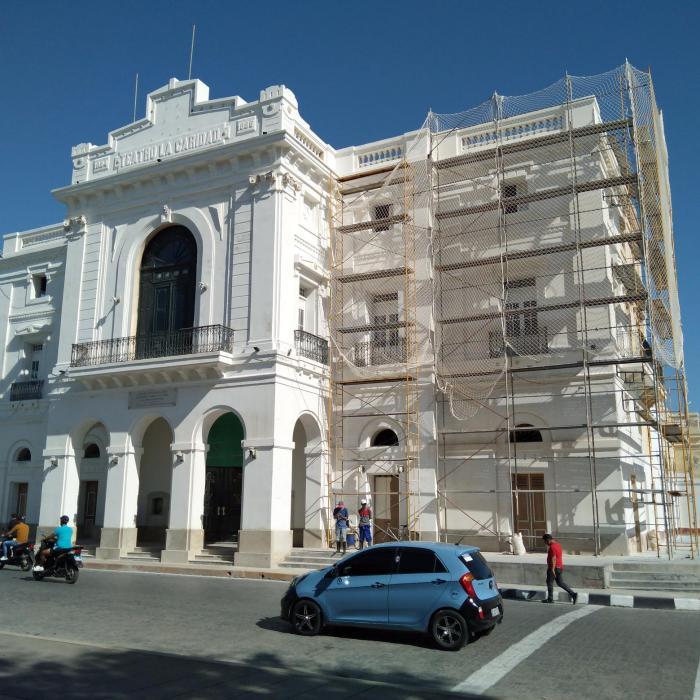
The capital restoration currently carried out at La Caridad Theater in Santa Clara, shows, if anything, the value given to culture in Cuba, which the Historical Leader Fidel rightly described as the sword and shield of the nation.
Founded on September 8, 1885, the theater has remarkable patrimonial, environmental and architectural values that made it the recipient of the condition of National Monument in 1982.
The old coliseum of Villa Clara was built thanks to the outstanding patriot Marta Abreu de Estévez, who had the happy idea of building a theater in the same space previously occupied by La Ermita de la Candelaria, the first temple built in the town, in 1696.
Marta Abreu, considered as the benefactress of Santa Clara, from the multiple works donated to her city, financed, with the permission and the funds of her husband Dr. Luis Estévez Romero, the construction of the coliseum, whose proceeds would be destined to humanitarian and charitable works.
The work, which was conceived by engineer Herminio Leiva y Aguilera, has a neoclassical style. The interiors of the theater were decorated by renowned Cuban and foreign artists of the time such as Miguel Melero, an outstanding painter and professor of the San Alejandro School, and the Filipino painter Camilo Salaya, who was in charge of the sides of the upper part of the mouth and the decoration of the ceiling, with the allegorical representation of the dawn, and three women symbolizing genius, fame and history.
The opening of the La Caridad Theater was a major turning point for the cultural life of the city. From that moment on, the most prestigious artists from the Cuba and abroad began to perform there.
A COMPLEX AND NECESSARY WORK
In order to restore Villa Clara's main cultural institution's splendor, a strong previous research process was necessary, with the participation of specialists from the Provincial Heritage Center, historians, planners and other renowned experts in the field.
They considered the original conception of the theater, the different interventions carried out there, especially the ones in 1980 and at the end of the first decade of the 21st century; which, despite being important to maintain its vitality, were incomplete, according to Domingo Ravelo Rodriguez, main investor of the work.
In the first major repair carried out, a thorough process that included the rehabilitation of the mural paintings by the painter Aida Ida Morales was made. However, several tasks were left pending, which made necessary another restitution between 2008 and 2009, explains Ravelo Rodriguez.
"In view of the deterioration suffered during these years, a general survey of the state of the facility was made, and serious constructive and structural problems were detected, which made it necessary to undertake a major repair of the coliseum," the expert acknowledges.
Among these difficulties, Ravelo Rodriguez mentions the existence of dozens of deteriorated beams; a lot of wood with termites; bad condition of the roof, which damaged the quality of the mural paintings; in addition to problems in the furniture and other patrimonial objects of the facility.
In this regard, he explains that the work was divided into three parts, the first includes the Marta Abreu hall, the rehearsal room, the lobby, the cafeteria and the Artex store, among other places where considerable progress was made, which precedes the more complex work in the part known as the heart of the theater, comprised of the boxes, the stalls, the soirée hall, the ceiling, the stage and the mural paintings, the latter task will be undertaken by restorers from the Office of the Historian of Havana, explained Ernesto Alejo, director of the institution.
So far, work has been done on the floor of the rehearsal room, where several collapsed beams were replaced; on the main and secondary staircases; on the false ceilings of all levels; in addition to intervening in the lobby and the gates of the facility, explains the Ddirector, who also said that specialists from the Cuban Fund for Cultural Heritage are working on the replacement of the stage furniture, the carpentry, the mural paintings in the lobby, the mirrors and the heritage lamps located in that place, as well as the stained-glass windows.
Other major works include the caulking of the theater walls, the repair of the trusses and the façade, which has been restored to its original elements, says Lizbeth Sánchez León, who praises the historical research work carried out by the Heritage Center.
On the subject, the director of the theater recognizes that this is the most thorough restoration work that has been carried out on the building, taking into account the magnitude of the different projects undertaken and their quality.
There are still a number of major works pending, such as the repair of the plumbing and electrical installations, the installation of the air conditioning system and the waterproofing of the roof, all of which require resources and a great deal of effort to complete the restoration work as soon as possible.
Despite the difficulties, the will of the theater workers themselves, who in an effort worthy of admiration, keep alive the programming with activities for children and adults on weekends; of the specialists involved in the restoration and of the authorities of the territory and the country, is to move forward with the works, aware of the value of La Caridad tTheater for Cuba’s and Villa Clara’s culture, said Ernesto Alejo.


