

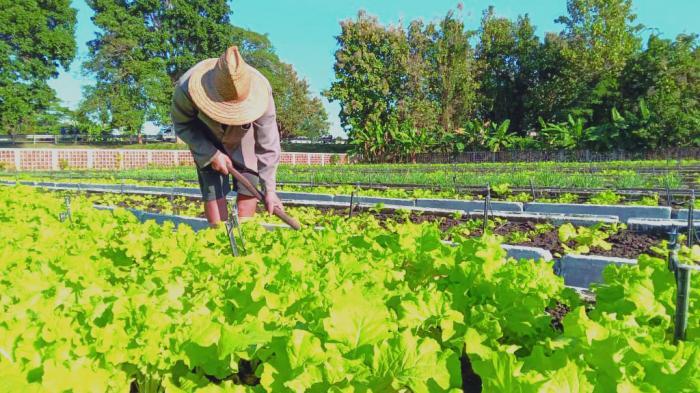
Pinar del Río.—"Here, one crop is harvested and another is planted right behind it. We never have unplanted beds." Dany Mena García pauses from his work to point out what is obvious to the naked eye.
For a long time now, the organic garden known as La Erea, located on one of the banks of the Guamá River in the city of Pinar del Río, has resembled a garden that maintains different shades of green 12 months a year.
When seeds are scarce, relatives send them from abroad, and when the electricity shortage began to jeopardize the irrigation system, an international collaboration project donated a new one that runs on solar panels.
Therefore, there are always vegetables and greens being harvested in its 49 beds.
"The acceptance is tremendous. People come here to find everything. As it is an organic garden that is in permanent production, people start arriving early. I don't know how many have already passed through our point of sale today."
Like Erea, thousands of similar facilities confirm the validity of this experience promoted by Army General Raúl Castro Ruz 38 years ago.
In Pinar del Río alone, there are more than 300 that have helped to promote a culture of vegetable consumption among the population for several decades.
THE PATH TRAVELED
They say that at first this was not the case, and that part of the harvest had to be thrown away due to lack of demand.
It is even claimed that in the beginning there were many detractors who questioned the idea of using resources to build garden beds in the middle of the city when there was so much unproductive land in the countryside.
Life, however, would ultimately prove those who persevered in pursuing a new model of agriculture right.
Thus, chard, spinach, chives, carrots, beets, and about twenty other crops would eventually become part of the diet of many people, along with the small group of vegetables (tomatoes, cabbage, cucumbers, lettuce) that had been available until then.
The Urban, Suburban, and Family Agriculture Program has established itself as the fastest way for Cuban agriculture to produce food after the impact of cyclones and other extreme weather events.
In 2022, for example, Hurricane Ian destroyed more than 8,000 garden beds in the organ gardens and semi-protected crops of Pinar del Río. However, in just over a month, vegetables such as lettuce, chard, spinach, and chives were already being harvested.
In addition, other crops were in an advanced stage of development, such as cucumbers, beans, tomatoes, carrots, and cabbage.
Lérida María Sánchez Díaz, head of the department that oversees this valuable program at the Provincial Delegation of Agriculture in Vueltabajo, explains that it currently covers 1,244 production structures and a total of 1,278 hectares distributed among organic farms, technified plots, intensive gardens, semi-protected gardens, and rustic greenhouses.
In these areas, average production in 2025 has been 10.2 kilograms per square meter.
This figure is in line with forecasts made at the beginning of the year and confirms the importance of this experiment, even amid all the limitations imposed by the current situation in Cuba.
Sánchez Díaz states that, by the end of December, some 5,000 backyards will also have joined the program in the province, bringing the total to 65,000, which contribute to the self-sufficiency of families and communities in Pinar del Río.
However, he acknowledges that there are also issues that need to be addressed, such as obtaining organic matter and the availability of labor.
However, he acknowledges that there are also issues that need to be addressed, such as obtaining organic matter and the availability of labor.
In this regard, the autonomy that productive structures now have to manage themselves, raise wages, and secure part of the necessary resources has been positive.
Miguel Espinosa Correa, administrator of the organic garden Ingeniería #1, located in the Hermanos Cruz neighborhood of the Pinar del Río capital, recalls that the motor pump for the irrigation system burned out and they waited two years for a solution because the urban farm to which they were subordinate had no way of buying another one.
"As soon as we became usufructuaries, we said: with this month's money, the first thing we have to do is solve the pump problem. So we went out, bought it from a small business, and solved the problem."
After 21 years at the helm of this unit, which currently combines 0.5 hectares of garden beds and two hectares of conventional land, he says that 2025 has been a very fruitful year for the program.
Ingeniería #1 was another of the organic gardens in the territory to benefit from new irrigation systems powered by solar panels, thanks to an international collaboration project to promote the use of renewable energy.
Through other initiatives that also bore fruit during the year, promoted by the United Nations, the European Union, and the Japanese Embassy in our country, they received seeds, new equipment for the canning and condiment processing center, and a tricycle to help market their products in neighboring communities.
With these, they are now taking the first steps towards obtaining dried condiments and dehydrated medicinal plants, in order to continue expanding the range of products available to the population.
"Demand has been growing, and that is an incentive to produce more," he says. So, 38 years after the creation of the first organic gardens in the province, instead of dealing with skepticism, today Urban Agriculture faces the demand to surpass itself and multiply its results.


