

Yolanda and Fermín Rodríguez Díaz were 11 and 13 years old, respectively, when they were murdered on January 24, 1963, at the La Candelaria farm in Bolondrón by the gang of Juan José Catalá Coste, which operated in the southern part of Matanzas.
Similarly, on March 13, 1962, in San Nicolás de Bari, then in Havana, the young Andrés Rojas Acosta was hanged with the same rope he was using to tie up his pig, a crime committed by the gang of the mercenary Waldemar Hernández.
On October 10, 1960, on the road from Madruga to Ceiba Mocha, Gerardo Fundora’s gang fired on a jeep passing through the area, an incident in which 22-month-old Reynaldo Núñez-Bueno Machado and his mother were killed.
Another child, Albinio Sánchez Rodríguez, was only ten years old when, on March 4, 1963, Delio Almeida’s gang shot him to death in retaliation for the attack they suffered at the hands of the National Revolutionary Militia forces.
Although more than 60 years have passed, the pain of these families remains raw, because the wound caused by the death of a child never heals.
So how do we tell those parents, grandparents, and siblings that Cuba is not the victim of the terrorist acts that have cost this people so many lives, but rather a threat to U.S. security, as its authorities have stated?
How can we explain to generations of Cubans who have lived under the empire’s constant harassment that the murders of volunteer teacher Conrado Benítez García and peasant Eliodoro Rodríguez Linares, of teacher Delfín Sen Cedré and young literacy worker Manuel Ascunce Domenech alongside peasant Pedro Lantigua Ortega, at the hands of armed gangs organized and financed by the United States, were not acts of terror committed against young people who only wanted to eradicate ignorance in Cuba?
Those who hatched those plans were the same ones who shattered the dreams of Nemesia Rodríguez Montalvo, the young girl from Carbonera who, at just 13 years old, saw her mother die and her little brothers wounded by Yankee shrapnel at Playa Girón.
In the fighting against the treacherous mercenary aggression, 176 people perished and more than 300 were wounded by enemy fire—including local residents who were mowed down by aircraft—of whom 50 were left unable to perform their duties, and all simply because a foreign power resented the existence of a Socialist Revolution just 90 miles from its shores.
These losses were in addition to the 549 dead and a considerable number of wounded, including regular troops and militiamen participating in operations against the gangs that operated in various parts of the national territory until 1965, as well as personnel killed by these gangs.
As can be seen, the price Cuba has paid to exist as an independent and sovereign country has been very high. Just a few months after the triumph of the Revolution, the U.S. government, under the Republican administration of Dwight D. Eisenhower, began to carry out its aggressive plans to eliminate the nascent Revolution.
On March 17, 1960, during a meeting attended by Vice President Richard Nixon; Secretary of State Christian Herter, and key leaders from the CIA and the Pentagon, the U.S. president approved the so-called Covert Action Program against the Castro Regime, proposed by the CIA, which, among other things, authorized the creation of a secret intelligence and action organization within Cuba, for which significant funds were allocated.
This is how banditry took root and terrorist acts against the Greater Antilles increased. On February 7, 1960, a small plane set fire to 1.5 million arrobas of sugarcane at the Violeta, Florida, Céspedes, and Estrella sugar mills in Camagüey.
As part of the so-called Operation Silence, organized by the CIA, between September 1960 and March 1961 alone, 151,000 pounds of weapons, ammunition, and equipment were airlifted to supply the gangs operating in the Escambray.
One of the first terrorist acts by the U.S. government against our country was of a monstrous nature: the sabotage of the French ship La Coubre on March 4, 1960, at a dock in the Port of Havana. The ship had loaded in Europe a large shipment of arms and equipment purchased from the Belgian national industry by the Revolutionary Government of Cuba, which was already concerned about the United States’ growing aggressive actions.
This terrorist act left 101 dead and hundreds injured.
Equally monstrous was the arson and total destruction, in April 1961, of El Encanto, the country’s largest department store, carried out by Carlos L. González Vidal, a member of the terrorist group known by the acronym MRP. The consequences of this disaster were not only economic in nature, but also something far more painful: the death of worker Fe del Valle Ramos, and the burns and injuries suffered by 18 other people.
As part of those same terrorist plans, an attack had taken place a month earlier, on March 13, 1961, on the Hermanos Díaz refinery in Santiago de Cuba, in which 27-year-old sailor René Rodríguez Hernández, who was on duty, was killed, and 19-year-old Roberto Ramón Castro was seriously injured.
A month later, on May 28, 1961, terrorists set fire to the Riesgo cinema in the city of Pinar del Río during a children’s performance, an act in which 26 children and 14 adults were injured.
On September 5, 1963, two twin-engine planes dropped explosive devices on the city of Santa Clara, killing teacher Fabric Aguilar Noriega and wounding three of his four children.
The attack carried out on October 12, 1971, by a speedboat and a larger vessel—both coming from U.S. territory—which machine-gunned the civilian population, killing two people and wounding several residents, was a painful event for the inhabitants of the town of Boca de Samá, on the northern coast of the former Oriente Province.
During those years, terrorists also targeted merchant and fishing vessels from Cuba and other countries in the Florida Straits. On October 4, 1973, the Cuban fishing boats Cayo Largo 17 and Cayo Largo 34 were attacked by two gunboats manned by terrorists, who murdered fisherman Roberto Torna Mirabal and abandoned the others on rubber rafts, without water or food.
However, the most monstrous and repugnant terrorist act committed against Cuba during that period took place on October 6, 1976, when an airplane exploded in mid-flight with 73 people on board, including the 24 members of the youth fencing team who had just won all the gold medals at a Central American championship.
And like those, for many years other terrorist acts were carried out against our diplomatic personnel; fishermen; soldiers guarding the borders near the illegal U.S. naval base in Guantánamo; and tourist facilities, where bombs were planted causing death and destruction—to name just a few examples.
Special mention, which reveals the total lack of scruples among the circles of power, must be made of the more than 600 plans devised by that country’s leadership to physically eliminate the leader of the Cuban Revolution, Fidel Castro Ruz, all of which were thwarted thanks to the expertise of the State Security Agencies.
The criminal policy against Cuba has also included biological aggression, which has claimed precious human lives, including children and pregnant women. How can we forget the deliberate introduction of hemorrhagic dengue in 1981, which resulted in a total of 116,143 hospitalized patients and 158 deaths, including 101 children.
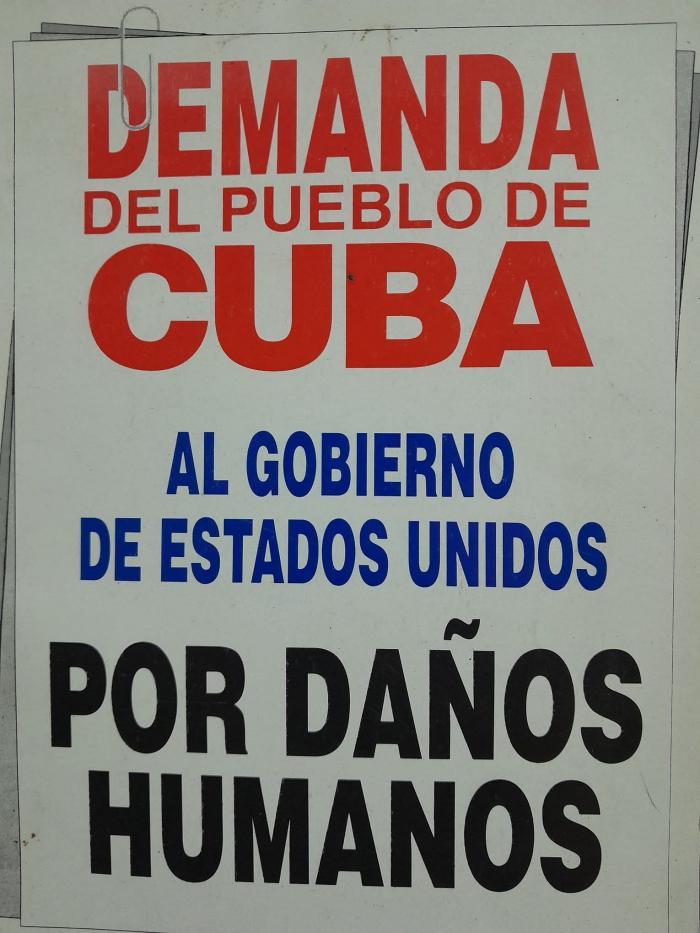
U.S.-funded terrorism against the Revolution, conceived as a matter of state policy, was historically reflected in the Cuban people’s claims against the U.S. government for human (1999) and economic (2000) damages; however, for 67 years, and with a ferocity unmatched in modern times, our country has never ceased to be the prime target of the empire’s hostile policy.


