

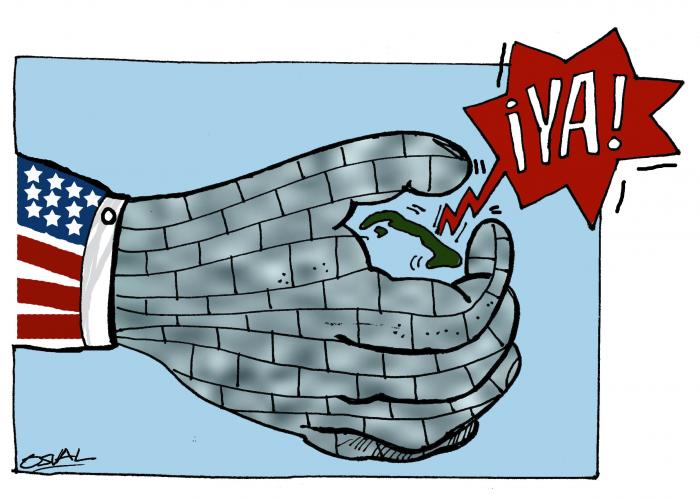
As the vote at the United Nations General Assembly approaches, the Cuban people once again arrive at this forum with their heads held high—bearing the weight of an unrelenting siege. As both the authorities and the people of this island have rightly pointed out, the term "blockade" no longer suffices to capture the full extent of such stifling pressure.
It is no coincidence that the international community has repeatedly and overwhelmingly supported the Cuban resolution calling for an end to this inhumane policy. Last year, 165 countries voted in favor of ending this economic, commercial, and financial war.
Yet, the "empire"—deaf to the collective voice of nations—continues to intensify its pressure, threatening third-party countries and persisting in a form of collective punishment that falls squarely upon the shoulders of the people of this heroic island.
The figures are staggering. The latest report from the Cuban Foreign Ministry quantifies the damage caused by this genocidal policy between March 2025 and February 2026 at an astronomical $8.083 billion—a record 7% increase over the previous period—bringing the cumulative historical total to a chilling $178.7 billion.
The blockade does not merely represent "unavailable" funds; it drives up the cost of imports—such as medical equipment, medicines, and educational technology—and hinders access to financing. For this reason, the Cuban Foreign Minister has noted that, in the absence of the blockade, Cuba’s GDP in 2025 would have been 10.8% higher.
Behind these figures lies a reality that cuts to the very core of the Cuban household. The energy blockade—intensified by Washington to unimaginable extremes—is no abstract concept; it is the mother cooking with firewood because there is no gas; the elderly person climbing ten flights of stairs on foot because the elevator is broken; the student doing homework by the light of a candle or a phone with a battery on the verge of dying.
In the realm of healthcare, the cruelty reaches truly shocking proportions. The blockade prevents the arrival of fuel for ambulances, reagents for laboratories, and medicines for pharmacies. Infant mortality—a metric that Cuba managed to keep in check for decades through a free, public healthcare system admired worldwide—has doubled.
These are children who should not have died, families who should not have had to mourn, and dreams cut short by the whims of an empire that refuses to forgive the audacity of a small nation that chose to be free on January 1, 1959.
Swiss oncologist Franco Cavalli, with five decades of experience and a deep understanding of the Cuban healthcare system, has categorically described this policy as "an attempted genocide," as it seeks to kill an entire nation through hunger or disease.
This is no rhetorical exaggeration; it is a clinical description of a strategy designed to break the will of a people by depriving them of the most basic necessities. Meanwhile, thousands of containers filled with medical supplies remain held up or scattered in ports around the world—victims of the fear that shipping companies and financial institutions harbor regarding potential reprisals from Washington.
Now, if—as the United States itself claims—the true cause of the hardships in Cuba is not the blockade, then the question answers itself: why not lift it? Basic logic dictates that if an obstacle hinders a people’s development and well-being, the solution is to remove it, not to intensify it.
Yet, logic has no place here; instead, there is a policy of force that, for nearly seven decades, has unsuccessfully sought to bring an island—which has shown unwavering resilience—to its knees through hunger and despair.
The U.S. government pressures other nations to support its "collective punishment" and to change their votes at the UN—a "frenetic display" that only confirms the moral isolation in which it finds itself.
Despite everything, Cuban dignity stands tall. And it is here that the words of the "Apostle" take on a striking, profound relevance. José Martí, who dedicated his life to Cuba’s independence and the unity of "Our America," warned in his essay "Our America" (1891): "The seven-league giant is already on its feet, and it is walking—and it must be stopped at the gate."
Hopefully, one day—grounded in mutual respect and self-determination—this barrier of hatred will fall, making respectful dialogue possible. Cuba is prepared for this; it is not the one imposing a blockade or engaging in harassment. The island has neither imposed unilateral sanctions nor closed the door to cooperation; rather, it is the party suffering under an economic siege—a situation it denounces every year before the UN General Assembly.
Any gesture toward rapprochement would be met with a genuine willingness on the part of the Cuban people, provided it is based on respect for their sovereignty and self-determination—without conditions or demands aimed at altering the path freely chosen by this nation.
When that day comes, the island will finally be able to breathe, unburdened by the crushing weight upon its chest. The entire world will recognize that Cuba did not surrender—that it remained standing even when everything conspired against it. In the meantime, we trust that the voices of the majority of nations will once again resonate within the UN. More than just a vote, this will serve as a reminder to those who persist in maintaining this crime: the world views them with contempt, while Cuba continues to sow life and hope.


