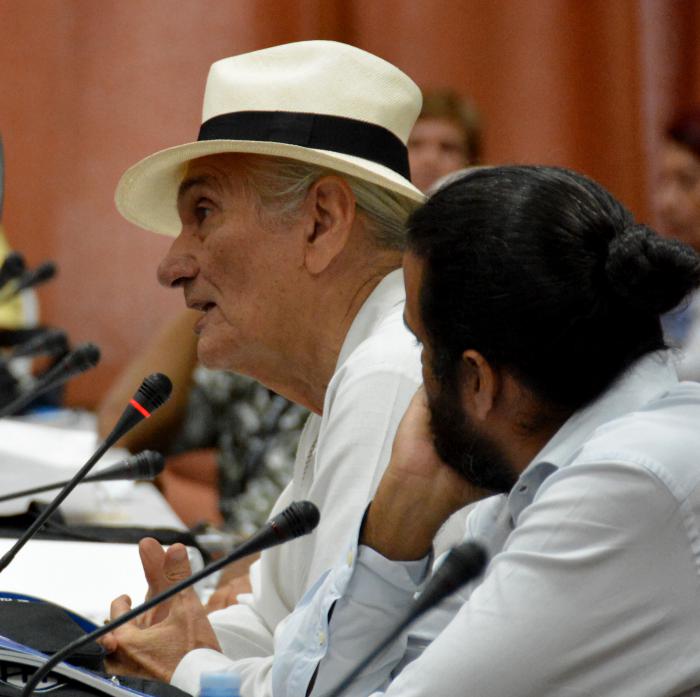
The recently concluded UNEAC Congress rolled up its sleeves to address “the urgency of structuring, via the Union of Writers and Artists of Cuba, and along with cultural institutions, the participation of critics and experts in the design and implementation of a strategy for the development of artistic and literary criticism in the media, in all media where new technologies offer opportunities.”
This quotation comes from the final report by the organization’s committee on Culture, media and social networks, but the issue had been raised earlier in the pre-Congress document debate, which cited the public’s need for references to "to evaluate and demand" meaningful works of art and cultural events.
In other standing committees, the urgency of recovering the role of criticism in times of indiscriminate consumption, when, in the absence of authoritative voices, what is worth less can be imposed over what is worth more with overwhelming power.
Let us recall that artists, critics, and audiences are three indivisible parts of one communicative phenomenon, despite the fact that there are creators, like Antonioni, who insist that they have never once read a critic’s review.
Picasso didn’t think much of them, either, but he read them for fun, he said. Buñuel admitted that he respected and followed criticism, in hopes of discovering in experts’ observations aspects of his films that he had not intended. “Some of them have more imagination than I do,” he said jokingly.
There are artists and writers who throughout their lives insist that they do not take critics into account, and later, among their papers, appear clippings of newspaper articles underlined and analyzed, with disparaging or positive words noted in the margins.The artist appears first, then the audience and, lastly, the critic. The artist continues to create regardless of the last actor, but one wonders how much influence the specialized assessments may have had (without forgetting the role of spectators or readers). Would the development and evolution of different trends and currents in art have been the same without the questioning or dazzled eye of the critic, who took care to leave evidence in books and commentaries that today serve as references for humanity?
Artists and the public need critics, not for judgmental or conclusive opinions, but as referential points to guide the exchange of ideas. One can disagree, and so much the better if this is based on analytical thinking, or even emotion, but civilization, some time ago, gave rise to the specialist, to promote the exchange of opinions and the development of knowledge.
A civilized dialogue, in which the critic is aware of all interesting works emerging in the public eye regardless of the attention they attract, clarifies the true value of a creation.
This can be an exercise in which critics, without being presumptuous, can give evidence of their best arguments, sensibility, and knowledge. They must stay away from “personal tastes,” and non-artistic factors like friendships or aversions, mistakes that, given the respect the public deserves, can lead critics to betray the very mission they assume.
Art and culture in general, for their development, require a constant critical dialogue that takes advantage of every space and medium, especially at a time when the thinly veiled garbage of cultural neoliberalism seeps in through every crack.
This was discussed a good deal at the UNEAC Congress, as well. And key aspects of a strategy were outlined, one that, we hope, will not long in coming.