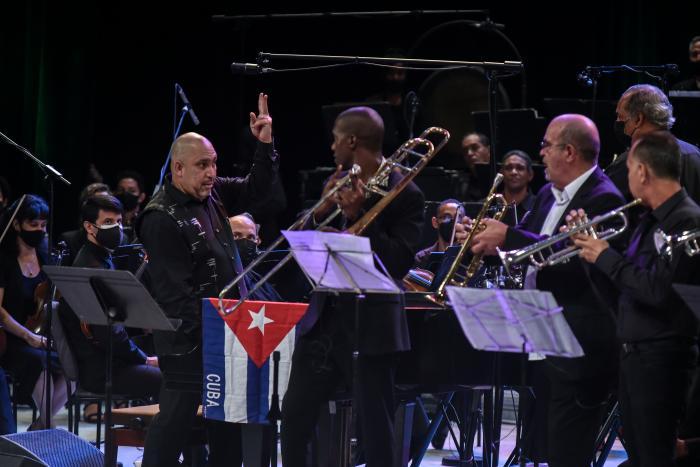
Once again the Jazz Plaza Festival arrives and, with it, the eyes of dissimilar artists that orbit around it. From all instrumental fields, musicians from many countries who find in the jazz language the necessary pretexts to converge, on this side, together with young and acclaimed artists.
Today I want to show the face of solidarity and tenacity, the latter less known in some Cuban musicians living in other countries, and that others carry with healthy pride. Such is the case of Nachito Herrera, an Artemisa-born pianist and composer who has been living in the United States for more than 20 years.
In this musical adventure, he returned to Havana with donations that exceed the carrying capacity of an airplane, so more than one flight had to be made. The pianist is known for his solidarity trips aimed at trying to alleviate the lack of instruments and accessories in the country's music schools.
In addition to his own personal efforts, he was assisted by U.S. organizations, foundations, friends and artists who have sent him not only great musical materials, but also medical supplies for Cuban pediatric hospitals.
A special load of wind instruments, both woodwind and brass, along with their accessories and other stringed instruments, were donated this week to several music schools, as well as some electronic instruments, such as synthesizers. In this line, a digital grand piano, from the prestigious Roland company, valued at approximately 15,000 dollars, stands out.
This instrument -model Roland GP609- belongs to the high-end pianos of that brand and integrates a new combining technology, where the traditional physical mechanism of a piano is merged with digital sensors. It retains the same architecture and way of hammering through the wooden hammers, but it does not do it on physical strings, but on electronic sensors capable of reproducing the desired sound taking into account the same conditions of an acoustic system.
In this way this piano achieves and identifies -with nanoseconds of response- the dynamics and sound intentionality desired by the performer, while maintaining the appearance of a three-quarter grand piano.
This is the first of three that will be brought to Cuba thanks to Nachito. It is, undoubtedly, an incentive for the various concert halls in the country. This work of altruism, according to him, is a way of thanking his country for having made him the artist he is, because those who do not love Cuba have no heart, he said.
Translated by ESTI