

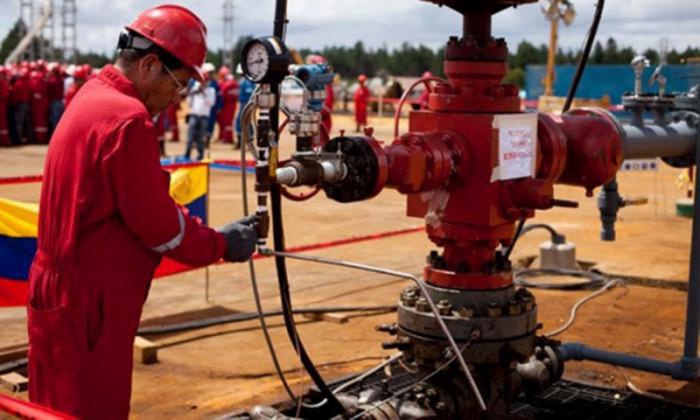
CARACAS.—The country with the largest proven oil reserves in the world has faced a drop in world oil prices over the past several months. This is just one element in the chain of events putting pressure on the Venezuelan economy, which some sectors are attempting to capitalize for political purposes.
Opponents of the Bolivarian process hope this will act as the final blow putting an end to the changes in the country initiated by Comandante Hugo Chávez. However, the government has taken advantage of the crisis, turning it into an “opportunity” to relaunch its economic system, by reviving production and riding itself of the dependence on so-called black gold, a disastrous legacy of the development model imposed in Venezuela since the first half of the 20th century.
The aim is to move away from a rentier state model to one where the country produces everything it needs to function, the President of the South American nation, Nicolas Maduro, said during a meeting with Bolivarian governors at Miraflores Palace on Sunday. Venezuela begins 2015 with an agenda focused on economic recovery including improving the redistribution of wealth.
The government also seeks to maintain social production, guarantee resources, reduce unnecessary costs and make alliances between state, private and foreign productive sectors. The plan is focused on counteracting the economic war faced by the nation, whose consequences – such as shortages of staple goods due to hoarding; smuggling; price speculation, etc – are a blow to a society accustomed to a high level of consumption. The authorities themselves acknowledge that an attitude of “that’s cheap, give me two,” which was very much in vogue during the years of the oil boom, has yet to change.
Added to this is inflation (about 60% last year according to official figures), and the devaluation of the local currency against the dollar, presenting a breeding ground for discontent among the population. However, the majority of the population has remained united around the government's call to avoid provocations and fight together to overcome difficulties. This economic war is also encouraged from outside of the country. The downgrading of Venezuela’s credit rating to triple C by the Fitch rating agency at the end of 2014 was no accident.
The aim was to prevent the country accessing the international credit needed to carry out what President Maduro has called an economic “renaissance”. Added to this is the pressure from the United States, which has applied sanctions against a number of Venezuelan government officials, freezing their accounts and withdrawing visas.
However, the measure that triggered the alarms was the “war of the market” against oil exporting countries, which according to the president was unleashed from the northern nation. On several occasions, Maduro has claimed that the fall in oil prices – down to nearly $50 a barrel – is a consequence of “flooding the market with techniques that destroy” such as hydraulic fracturing (fracking). Given this situation and in order to combat what Maduro has described as a “financial blockade,” the president announced an international tour that will take him to China and several member nations of the Organization of Petroleum Exporting Countries (OPEC).
The agenda will focus on discussions around the drop in oil prices, after the Venezuelan proposal to reduce production levels was rejected amid various pressures. “We want to lead a national and as far as possible, an international campaign, to restore, in the first place, the energy and oil market,” he said. Several measures have been taken to drive the Venezuelan economy and boost domestic production. Seeing difficulties as an opportunity for the “big economic change” the country requires, will determine 2015, as reiterated by President Maduro.


