

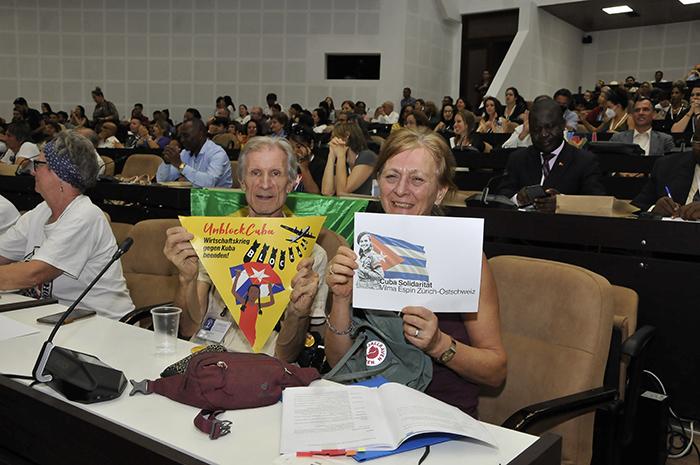
"Let no one believe that we are delirious or dreaming. We all know that this Conference will not solve the pressing problems we see today on our planet, but it is a grain of sand. The worst thing would be to remain with our arms crossed, without fighting, without sowing ideas, without raising awareness," said Héctor Hernández Pardo, coordinator of the José Martí Project of International Solidarity, at the opening of the 5th International Conference for the Balance of the World in Havana.
"If all of us who are here are accused of defending a utopia, let us respond immediately like the poet "At least it serves us to walk," he added, in clear reference to Eduardo Galeano, Uruguayan considered among the great writers and militant journalists of the Latin American left.
The members of the Political Bureau of the Communist Party of Cuba, Salvador Valdés Mesa, Vice President of the Republic; Esteban Lazo Hernández, President of the National Assembly of People's Power; Manuel Marrero Cruz, Prime Minister; and Dr. Roberto Morales Ojeda, Secretary of Organization of the Central Committee, were present on the first day of this event, which was attended by more than 1,100 delegates from 87 countries.
From the Havana Convention Center, where the meeting of ideas for a more humane present and future was held, Hernandez Pardo added that this meeting shows that Cuba is not alone, and that there is a large number of people willing to change the course that hegemonic policies are trying to impose on a global scale.
There is a common interest in the defense of peace and social justice; concern for climate change; the search for true participatory democracy and solidarity, he pointed out.
OUR NORTH IS THE DIALOGUE OF CIVILIZATIONS
The presence of José Martí, Apostle of Cuba's Independence and one of the great Latin American poets and thinkers of all times, was remembered by Doctor in Historical Sciences Eduardo Torres Cuevas, who gave the keynote lecture Martí and the balance of the world.
The Director of the Martiano Program Office highlighted the significance of Pope Francis' message of goodwill to the delegates, in which he emphasized "that everything we do should follow the best possible path."
The complex context in which these paths are being sought was also pointed out by the Cuban intellectual, who recalled the first of these international conferences For the Balance of the World.
In September 2001, there had been the attack on the Twin Towers in New York, and a month later there was the invasion of Afghanistan.
"The world had changed. A convulsive era was opening up in which the most terrible aspects of the new struggle for dominance of the planet would fall on the peoples of the so-called Third World. It was a process of imbalance, in which war would be waged on a planetary scale, not between great powers as it had been before, but on the basis of the alliance of the great powers against the peoples that form part of those communities of the underdeveloped or developing world," he recalled.
He said that, in the face of these processes that divided, confronted and deculturated peoples, it was necessary to promote the dialogue of civilizations, instead of speaking of a war of civilizations.
He also pointed out that many experts of José Martí's work interpreted his thoughts, of an uncommon sharpness, as lucid signs of the birth of a historical time in the face of which he was alarmed and gave the first alarm bells to avoid what today, with all intensity, burns and destroys what man has created and dreamed of.
The Apostle, added Torres Cuevas, was the creator of a liberating, humanist and democratic thought from a cultivated and deep feeling of love. He was, above all, a citizen of the world. His Homeland was universal and profoundly humanist, he added, although, without wasting time, he warned that at present the salvation of the human species depends on acquiring the awareness of what we have to change.
"Let us also think that we must have the awareness of what unites us, in order to win the challenges from within, win the world, " he concluded.


